

The social media algorithms have been at it again. Over the last year or so I’ve been fed many clips of a new-ish band called The Molotovs. This would seem to be because the band’s bassist, Issey Cartlidge, is an enthusiastic user of Rickenbacker basses. And she’s not the only one. I’m also recommended clips of UK bassist Becky Baldwin and YouTube dipstick Danny Sapko, both of whom are Rickenbacker users as well. Plus, a few weeks ago, I was inside a venue in Spain that was prominently displaying a large photo of composer/musician Hans Zimmer at a recent performance, in which he was proudly strapped into a Rickenbacker 4003 in a very lovely Desert Gold colour. The recent re-emergence of Canadian prog behemoths Rush, whose bassist/vocalist Geddy Lee is a long time Rickenbacker user, has also boosted the brand’s profile. So, it would seem that Rickenbacker basses are in again, and not for the first time.

This happens fairly regularly, most recently being the early 2010s, when they could be seen in the hands of bassists with Franz Ferdinand, the Editors, The Klaxons and Snow Patrol among many others. Before that, in the glory days of alternative rock in the 80s and early 90s you could find them in use by Mike Mills of REM, Kim Gordon from Sonic Youth, Lou Barlow of Dinosaur Jr, Tommy Stinson of The Replacements, Alex Griffin of Ned’s Atomic Dustbin and that bloke from Swervedriver (whatever happened to him?) to name just a few. From the punk/post punk era, bassists with Generation X, The Adverts, X Ray Spex, Killing Joke, The Jam, Black Flag as well as one of my favourite players, Paul Gray of The Damned/Eddie & The Hot Rods were all Rickenbacker users. I could keep going on further back and also include the obvious big names that I’ve deliberately omitted, but I’m probably labouring the point already. Suffice to say I am (and always have been) a massive fan of the Rickenbacker 4000 series of basses, of which I currently own two. However, that total should be three but more about that later.
The Rickenbacker company has a history going back to the 1930s. However, it had its roots in the National String Instrument Corporation (manufacturer of the tri-cone resonator guitars) for whom Adolph Rickenbacker held the post of chief engineer some years previously. In 1931 Adolph teamed up with lap steel player and inventor George Beauchamp as the Electro String Corporation to develop and market George’s ideas and the company can claim early successes with magnetic pickups, the ‘Frying Pan’ electric guitar and standalone amplifiers. Although the company’s name would remain as Electro String, the instruments themselves took on Adolph’s surname and were badged as Rickenbacker in the mid-1930s. Beauchamp retired in 1940 and Adolph Rickenbacker sold the company to F. C. Hall (Fender’s US distributors) in 1953, ushering in the modern era of Rickenbacker guitars and basses.
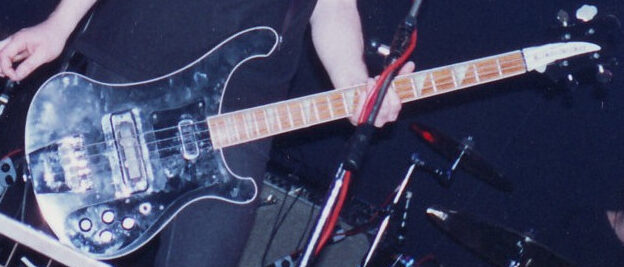
Where most guitar companies seem content to issue slight variations on each other’s products, Rickenbacker have always had a defiant streak of individuality. This maverick spirit runs through all their models, most of which have component parts with unique features. Admittedly this is not always a good thing, as anyone who has had to re-string a 360/12 will tell you, but you only have to look at a 4001 or 4003 to appreciate that it is a thing of wondrous beauty, they even look great in white which is a colour I’m not usually keen on for a bass guitar. The offset body with its large ‘cresting wave’ top horn should be horribly asymmetrical and ungainly but instead its graceful curve seems to sweep the eye onward down the neck toward the headstock which, with its smaller version of the aforementioned ‘wave’ makes the whole shape of the instrument balance perfectly. The body is surprisingly slender as you look at it from above, a thin flat slab that makes Fender basses feel lumpy in comparison. The neck has a similar vibe too, so slim and flat that it feels longer than it actually is, especially as the scale length is three quarters of an inch shorter than Fender’s. It certainly tempts you to go up the dusty end, which is an area I normally avoid, being a solid root note kind of chap. All this talk of its skinniness doesn’t mean that it is a delicate, fragile item though, the through neck construction and non-angle headstock keep things very solid. Compared to the kind of modern, streamlined basses common today or the sterile, high tech basses in exotic woods currently popular among the short strap contingent, the Rickenbacker bass could be said to appear a little old fashioned. But it is old fashioned in the same way that many classic guitar designs are i.e. styled after the tastes of the 1950/60s and using the technologies of the time.
The Rickenbacker 4001 (replaced in the early 1980’s by the visually identical 4003) has a beautiful retro futurist aesthetic that harks back an era of space exploration, bikinis, atomic testing, gas guzzling automobiles and the birth of colour TV. In a similar way to the original Coca Cola bottle, its curves are subtly feminine but the 4001/3 is somehow more sumptuous and seductive. It is almost vaguely erotic to run your hands over its elegant swoops and it’s a delight to indulge in the glorious rollercoaster ride of the dip and glide that leads to the crest of the top horn. It’s adorned with a considerable amount of chrome, which includes an oversized bridge/tailpiece with a gap toothed smile that evokes the grilles of the 50’s supercars, in a throwback to those times when shiny and mirrored were signifiers of all things classy and opulent. I’m sure that I don’t have to remind you that retro chic is fashionable (and has been for some time) and if Rickenbacker get some stick for their designs being ‘outdated’ then what does that say for the Strat, Les Paul, Telecaster etc? Those are probably the most popular guitar shapes on the market and they all pre-date the Rickenbacker 4000 series. In fact, as a response to the perceived demand for an updated version of the Rickenbacker bass, a modernised version (the 4004 series) was introduced in 1993 but only sold a fraction of what the 4003 did and, despite a few tweaks to the design over the years, was eventually deleted from the Rickenbacker catalogue in 2017.
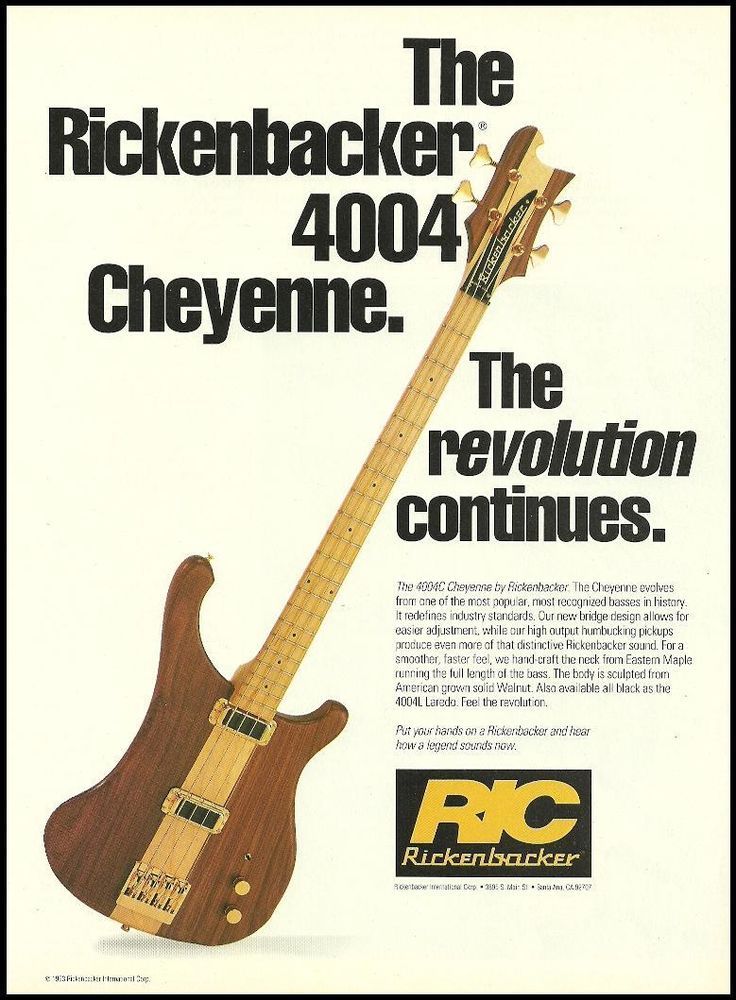
This latter fact is a good example of a strange kind of double standard among Rickenbacker’s critics, in this case the fact that the company addressed the issues voiced by consumers but very few of whom then went and bought the resulting product. Similarly, a quick perusal of the Rickenbashing that regularly occurs online will expose a blatant doublethink among many contributors. Take, for instance, the common complaint that the binding around the 4001/3 body causes abrasion during use. Why is this not a problem for Les Paul players? Or certain types of Telecaster? Or many of the other guitars and basses that come with slab bodies and binding? Is the Rickenbacker binding sharper than others? The detractors say so, but I own all three of the above instruments and I don’t feel a difference.
Then there is the complaint about the bridge pickup cover, that it is “stupid and gets in the way”. Well, if it gets in your way, take it off. It’s not difficult. It’s odd how many players are happy to go to great lengths to modify their instruments to their own personal specifications with no problems but the simple process of removing the Rickenbacker bridge pickup cover seems to be a big deal for some. As for it being ‘stupid’- how come Fender don’t get the same level of abuse? Bridge and pickup covers came with Fender basses for many years (and still do on some models) without the same level of derision. So many people removed them that Fender eventually stopped supplying them with new instruments- but at least Rickenbacker give you the option.
You can’t palm mute with that bridge, some say. I don’t get this because I can, easily. It means changing your hand position a bit but that is exactly what you have to do to use many different picking and plucking techniques so I have to admit this particular complaint baffles me. As does the subject of tail lift. The amount of whinging you come across in relation to this subject is astonishing, you would be forgiven in thinking that everyone’s bridges were folding in half. Once again, I can only go on my personal experience because I have two 4001s that have been strung up to pitch for 30 years and the amount of tail lift is no more than a couple of millimetres and in no way does it affect the function and playability of either. I believe the extent of this ‘problem’ is much exaggerated. But apparently something has to be seen to be done, so the mid 80’s fix was a couple of extra screws and the new V2 bridge is anchored at the rear.
A certain well known online bassist from the UK claims that you can’t slap on a 4001/3. Putting aside the fact that I’d see it as a positive attribute of the design, Mr Bassist should have really done a search on his preferred platform before making that claim. There are many videos available that show that his statement is simply not true. This one, for example.
I can’t believe that I’ve sullied my sacred pages by embedding that tripe, just to make a point. Let’s move on. “I don’t like that Rickenbacker tone” is another common complaint. Well, you don’t have to, it’s a matter of personal taste. It doesn’t mean that there is an inherent fault with the instrument. Besides, two very famous Rickenbacker players have made that characteristic ‘clank’ part of their signature sound. The company themselves have also addressed this situation, as since the mid-2000s the 4003 has had a push-pull pot installed that bypasses the tone capacitor responsible for that classic Rick sound, should you wish to not use it. It is also a very simple and easily reversable mod to remove this component from older 4001/3 models. So, this is really another non-issue. Don’t understand or need the Rick-O-Sound feature? Then don’t use it. A standard mono output jack is also included, only an inch away. Plug into that instead or buy a ‘S’ model- they are mono only and also come without body binding, putting two complaints to bed in one swoop.
Another gripe is that setting the intonation on the Rickenbacker bridge is difficult. It is not. It can be a little tricky however, depending on how the action is set, and you have to loosen the strings a couple of times but that’s no big deal for anyone with a little patience. If you think intonating a Rick is a pain in the arse, then just spend a while setting up Floyd Rose vibratos. That’ll teach you some perspective. Besides, Rickenbacker have recently introduced a V2 of their bridge, with individually adjusted saddles so there is now an authorised alternative.
High action at the first couple of frets? Lower the nut slots. It is common for guitars of any brand to come out of the factory with a medium set up, it’s a compromise to try to please most players and this practice is not particular to Rickenbacker. The same goes for fret size and crowning. Lacquer overspray on the fret sides? Well…on that one I do agree that it is shoddy quality control, but if you’d like to drop by my workshop one day I’ll show you a $5000 Custom Shop Strat with the same issue. So, on that front, Rickenbacker are no worse than anyone else, however in my opinion NO-ONE should be letting guitars out of the factory in that condition.
Finally, there is the main complaint- Rickenbacker truss rods. This situation is slightly different and has some validity but is mainly down to a misunderstanding, or more accurately a lack of understanding. The old-style twin hairpin truss rods, in use until 1984, do not adjust like the more common single or double action designs. Doing so will result in a high chance of damage to the instrument (namely fingerboard separation). The many documented cases of this are why Rickenbacker truss rods have such a bad reputation- and it isn’t the fault of the truss rod system it is the fault of the user. Instead of explaining all this myself, I’ll save space and time by just linking to Andy White’s excellent article on Rickenbacker truss rods which has all the info you’ll need and I’ll leave this topic with the fact that my 1980 4001 was set up to my specifications shortly after I obtained it in 1989 and hasn’t needed touching since. That hairpin system may be clunky, but it works remarkably well.

So, it would seem that a lot of the criticism that Rickenbacker basses receive is merely down to matters of personal taste and the fact that they are not Fenders, while perceived ‘faults’ and issues are generally down to the fact that the maintenance and set up procedures are not the same as other brands. All that said, it has to be admitted that Rickenbacker perhaps contributed to the situation on a few fronts. FC Hall’s son, John, took over as CEO in 1984 and his reputedly brusque and combative attitude to the company’s critics tended to put some people’s backs up, while the punitive warranty conditions that Rickenbacker also implemented didn’t help. The company was slow to correct a known issue with a new lacquer formula introduced in the early 2010s (although it is, again, interesting to note that Gibson don’t get the same level of abuse from owners of goldtops, which suffer from a similar problem). In addition, the relatively high price of genuine OEM parts was a bone of contention for some. Then, of course, there is the situation with Rickenbacker’s intolerance toward the existence of copies. For a long time, the company had what was widely seen as an overzealous habit of policing the sale, or sometimes the very mention, of copies of their products, which were mostly coming out of the manufacturing plants of Japan in the 70’s and 80’s. Strong arm tactics like threats and potential litigation from Rickenbacker towards retailers, distributors or even mere enthusiasts created resentment toward the brand that lasted decades and to be fair, from the receiving end, these methods must have seemed somewhat heavy handed, especially to unfortunate private sellers, who would see their ads removed from online platforms without explanation and with ruthless efficiency. Dig a little deeper though and Rickenbacker’s motives for these actions are understandable. Intellectual property and trade dress are rights that need to be actively defended in order to stay relevant (as Gibson found out in 2005 and Fender is having issues with in 2026). Unauthorised use needs to be challenged vigorously in order for a brand to show, in the eyes of the law, that it has always been actively protecting its products, design concepts and professional reputation from potential damage, which could be due to anything from mere imitation to the more serious problem of blatant forgery. This is, I believe, the real reason behind Rickenbacker’s attitude toward copies and not because of any perceived loss of income. After all, the company has always had no problem shifting their products as fast as they could make them (a situation that continues today) so much so that at one point the waiting list for some models ran into years.
There are five great historic American guitar brands* (Gibson, Fender, Gretsch, Martin and Rickenbacker) and each has weathered storms at various points over the years but of those five only Martin and Rickenbacker remain in the hands of the families that founded them and only Rickenbacker have never introduced a model manufactured outside the USA. All their manufacturing has taken place at the same facility since 1964 and- with an attitude that is almost anti-capitalist in its application- they remain defiantly opposed to expansion. Rickenbacker have never licenced their products to anyone, have never moved manufacturing overseas, do not have an affordable sub-brand (in the style of Squier, Epiphone or PRS SE) and prefer to remain working to capacity from their Santa Ana, California HQ under the watchful eye of John Hall’s son Ben, who is factory manager and guardian of the Rickenbacker legacy. Recent years have seen only subtle tweaks to the company’s designs although the ‘Rickenbacker Boutique’ service does offer occasional short runs and one-off specials. This is as near as the brand comes to opening a Custom Shop.
The distinctive character of the 4001/3 is not for everyone but it has found its way into the hearts of some notable artists- Paul McCartney, Chris Squire, Lemmy and Cliff Burton for example. So, trying one out will put you in good company. I lusted after one from my early teenage years, eventually finding the funds to buy a second hand 1980 Fireglo 4001 in 1989 (which I still have). My latest acquisition is a 1981 Black Trim I found in bad condition a few years ago, which was restored with extensive modifications. The gap in the collection, however, is a 1976 Jetglo 4001 that was sold without my permission by a vengeful ex-partner in the mid-90s and I’ve mourned its loss ever since. Hopefully it is still out there somewhere and will make its way back to me someday. The serial number is PL7996 and you’ll know if you have it because it has a DiMarzio Jazz pickup in the bridge position. Get in touch if you have no use for it anymore, it would be wonderful to be reunited. If Paul McCartney, Billy Corgan, Jimmy Page, Johnny Greenwood and Lee Ranaldo can all get instruments that have been missing for decades returned to them, there has to be still hope for me, right?

*I am well aware that there are other American guitar brands that have been active and successful for decades. However, I wanted examples that both existed pre-world war 2 and haven’t laid dormant for long periods since.