

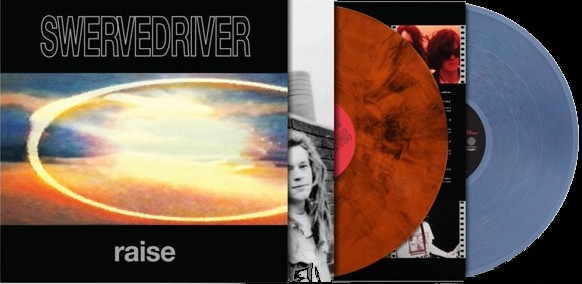
Over the last few weeks, I’ve been a bit blown away by the reception the recent 35th Anniversary edition of Swervedriver’s ‘Raise’ has received. It was awarded 8 out of 10 in both Uncut and Vive Le Rock magazines, while Mojo gave it a full page retrospective. The feedback from buyers has been overwhelmingly positive, the band have also been out touring in support of these releases and much of the UK tour was sold out. I’ve even ended up doing my first interviews in over 30 years, which was something I didn’t expect.
There was a small fly in the ointment though, in the fact that the original draft of the sleevenotes was way too long to fit into the available space on the sleeve. So, we ended up editing them down to soundbites, that hopefully told the same story but in abbreviated form. This worked pretty well but I prefer a longer read and, at the same time, it would be a shame if all that effort it took to write the original version went to waste. So below, in full, are the sleevenotes for the ‘Raise’ 35th re-issue as they first came off the printer.
When they told me what it was called, I thought “Yeah, Ray’s” and I pictured some rusty old gas station in the Badlands, dry wind tangling tumbleweed around mangled, dead engines. Then I thought “Yeah, rays” and I imagined the rising sun searing amphetamine eyeballs gazing along on an endless ribbon of black asphalt. Then they said “No- RAISE” and I thought yeah, that’s mighty fine too because it’s no accident that these guitars hit and run.
‘Raise’ is about rising above reality, a head on collision between fact and fantasy, between what is and what young men dream. Fuelled by epic disillusionment- “Your town ain’t lighting up no more”- it accelerates away from urban claustrophobia and heads for the imagined freedom of…somewhere, anywhere else. It’s not about being there, it’s not about arriving, it ignites on that moment of deciding to leave and revs on the throbbing tension between the taste of escape and the tug of the familiar. ‘Raise’ is the sound of the wheels spinning the second before you release the brake and consign your past to an exhilarating rush of images flashing back into history.
Like the other truly great albums made this year ‘Raise’ is an attempt to reconcile the promises we were reared on- holidays in the sun, handsome fashion spreads, smiling affluence, the mythical leisure principle- with the bitter truth of recession and human frailty. Incurably romantic, ‘Raise’ gets its rocks off raging against where Swervedriver actually are as much as it does panting about where they are planning to go. “Those kids on the corner wanna beat box my brains to bits” (Rave Down) “It seems so real I can just close my eyes and its here” (Feel So Real). It’s a gloriously precarious balance, a symbolic fuck you to the blank generation. Swervedriver are, literally, sensational. Whether its frustration or anticipation, getting bombed (the slow motion skid of ‘Deep Seat’, the thunderous rush of ‘Sandblasted’) or getting ready (‘Lead Me Where You Dare’) Swervedriver refuse to be numb. The guitars scald like burning oil but the vocals are always downbeat and voyeuristic, fanning the flames of ‘Pile Up’ and the twisted chassis of ‘Son Of Mustang Ford’ with deeper symbolism. Like musical method actors, Swervedriver are god’s grease monkeys. They look beyond.
‘Raise’ is a great road movie for the ears and a postcard sent back from the edge to those who cast an eye over Swervedriver’s origins, lazily lumped them in with the scene…and then ignored them. Wish you were here? No way suckers! Eat their fucking dust!– Steve Sutherland. ‘Raise’ album review, Melody Maker magazine, September 28th 1991.
Probably due to the lyrical content of ‘Son Of Mustang Ford’ the British music press had become fond of invoking imagery of lonely highways and epic, empty landscapes when referring to Swervedriver’s work and allusions to cars, escape and travel were common too. It therefore became something of a joke (as well as a closely guarded secret) among the band and their entourage that only one of the four musicians actually had the advantage of holding a driving licence at the time. Therefore, when the ‘Raise’ recording sessions began at The Greenhouse Studios, London, during March 1991 and this person was otherwise occupied, the rest of the band had to suffer the ignominy of most of their equipment being transferred from their Camden Town headquarters in a fleet of black London taxis. Spacious vehicles, to be sure, but somewhat lacking in the style and charisma of the muscle cars the band had become unwittingly associated with.
But transportation wasn’t the only teething trouble the album had suffered in its preparation. Potential producers had been an issue. Alt/rock legend Bob Mould (of Husker Du/Sugar) was everyone’s favourite but at that time he was deep into the writing of the ‘Copper Blue’ album and was understandably reluctant to put his muse on hold. Alan Moulder was also unavailable, while the inspired suggestion of Wayne Kramer unfortunately didn’t come to fruition. None of the other candidates seemed to be the right fit (including the bizarre suggestion of Andy Taylor of Duran Duran). With time running short and deadlines approaching, basic tracking started with the band self-producing and Philip Ames, one of the roadcrew who also had extensive studio experience, in the engineer’s chair. The band’s intention was to create something more multilayered and expansive rather than just more songs in the clamorous, up-tempo nature of much of their earlier work. Guitarist Jimmy Hartridge was interested in making “a good headphones album”. The only nod to the band’s past would be a re-recorded, cleaned up version of debut single ‘Son Of Mustang Ford’.
The Greenhouse Studios was owned and run by Pat Collier, former bassist with UK pseudo punks The Vibrators and consisted of two studios. The larger and more expensive of the pair was on the top floor but studio two, on the ground floor, had a well renowned drum room and was Swervedriver’s preferred choice. When the ‘Mustang Ford’ EP had been recorded in spring 1990, The Pixies had just finished using studio two to record drums the previous day. “The band had worked in the studio before” says Philip Ames “it was dominated by the drum room, which Graham was obviously familiar with, so he knew what to do to get what he wanted out of it. The desk was an Amek Angela, not the biggest or most sophisticated unit but pretty solid sounding and reliable”.
It is common practice during studio sessions for musicians to play in the control room, with the speaker cabinets isolated a safe distance away, at the end of a run of long cables. Swervedriver were not interested in this idea. According to Philip Ames “I loved that they were concerned about the kinetics of the whole thing. Their opinion seemed to be that being close to the amps and feeling the energy, the bluster and the air moving off the speakers made a bodily chemical change and psychological difference in their playing; to a freer and more open manner. And as the studio had been built with plenty of glass doors and windows between all the different areas, there were really good sight lines everywhere, allowing for great visual communication. So, a small hallway, just to the right of the control room could also serve as an isolation booth and Jimmy was set up in there with a Les Paul, Telecaster, Marshall head and cabinet and a Fender combo of some type. Can’t remember exactly what it was but it had brown tolex. The main studio area had two more booths, a larger one directly facing the drum kit was where we put Adam, his Marshall half stack and Vox AC30”. In the far corner, Adi Vines was crammed into a mere 8 x 4 foot bass booth with a full 300 watt Ampeg stack. “Both channels of the amp were in use” says Ames “one deep and boomy and the other overdriven and distorted, which we then mixed on the amp’s front panel. The intention being to aim for- in Adi’s words- something like Lemmy playing dub reggae”.
Unlike some of the bands they were later lumped in with, Swervedriver didn’t affect a swirly, vaporous kind of sound. “They were much more rock ‘n’ roll then that” Ames adds “They didn’t own any modulation FX- no chorus pedals, phasers or flangers or any delays or echo units. Jim and Adam just had Wah Wahs and a selection of overdrive and distortion pedals. Adam was just beginning to experiment with reverb though, and that added some nice spacey elements here and there. There was also some tremolo involved but I think that came from the AC30”.
Creation Records had a history of not interfering with their artists during recording sessions and Swervedriver were no different. “There was little or no oversight from the record company” says Phil Ames “They trusted their bands to make the records they wanted to make. Alan McGee visited once and seemed happy with what he was hearing so we were just left to it. The band were night owls so we wouldn’t start until the afternoon and would work late. They had some friends who were recording in the top studio and we were very amused to see them clock off and go home at 11pm sharp every night. We were only just getting into our productive zone by then”.
Most of the new songs had been demoed by the band over the preceding few weeks but some changes were still to be made. “Deep Seat was completely re-arranged from the demo version, Adam also changed or added more vocals to a couple of songs. They also laid down a couple of improvised ideas, one of which ended up as an interlude between ‘Feel So Real’ and ‘Sandblasted’. Graham and Adam were waiting for the other two to be ready between takes and made that up on the spot”. But what ended up being added most of all were the guitar overdubs. “Guitar parts just kept coming” says Phil Ames “Adam and Jim were bursting with ideas for new parts. Not just the usual tricks like double tracking to thicken them up but different phrases and counter melodies, complementary motifs and other embellishments. It wasn’t unusual to end up with about half a dozen new parts appearing on a song. They weren’t afraid to pile it on and we ended up with this dense wall of guitars. I didn’t envy whoever was going to end up sorting it all out during the mix”. This density would become one of the album’s defining characteristics and has subsequently been noted and commented on many times in the years since the album’s release.
During the recording, it became clear that the preceding two EPs had provoked interest in the band worldwide and there was now competition to licence the band overseas. A&M Records in the USA were leading the pack and the label’s Julie Panebianco (who had been closely involved with REM and Husker Du during their time on major labels) had fallen for the band hard. “I think the first song I heard by Swervedriver was ‘She’s Beside Herself’ because I loved the title and I went to listen to it first” she recalls “I can’t remember if I bought the EP myself or I got it from Alan McGee but I know I called him immediately and said I want to sign this band. The guitars, viscous and powerful, the melodies, Adam’s voice, the music- dare I say the beauty of it- building to a majestic crescendo. Then after I listened to ‘Rave Down’ and the lyrics “He blasts flies with his gun, because swatting’s no fun” I was in. Adam’s lyrical touch doesn’t get enough attention but even their song titles have very provocative, literate, and cinematic touches and their music carried an emotional weight the titles lived up to. Plus, they looked good too, cute and very cool. They were a guitar band girls could dig as Jimmy and Adam didn’t bury the melodies under husks of lead. Adi’s bass and Graham’s drums were muscular and they moved in a sinuous rhythm. I went to London, met them in the studio where they were recording ‘Raise’ and I loved them. I never really told them that they are one of the bands I am most proud of ever having anything to do with, but they are and also so many musicians now mention them to me as an influence”.
Basic tracking took about two weeks and then recording moved to Falconer Studios in North London for final overdubs and vocals. Anjali Dutt then took over the chair for the mixing stage. She already had a relationship with the band, having recorded and mixed the ‘Rave Down’ EP a few months previously, had also mixed Spacemen 3’s ‘Recurring’ album and- at the time of the ‘Raise’ sessions- was fresh from engineering parts of My Bloody Valentine’s ‘Loveless’. She later recalled her first encounter with Swervedriver. “I was petrified because they seemed to me like such a boysy guitar band. They were loud, noisy and heavy. The indie/grunge thing was still new and hadn’t really taken off at the time, so it was not entirely on my radar. I remember listening to them for the first time and thinking- my god, what am I going to do with this?”
Mixing took place at The Farmyard Studios a short distance from London. Housed in actor Dirk Bogarde’s former home at the end of a long, tree lined drive, the house had original features such as deep-set windows, exposed oak beams, quarry tiles, carved oak fire surrounds and characterful room shapes. The residential accommodation included the bedroom that Elizabeth Taylor previously slept in. “The old barn housed the control room and live recording area” says Anjali Dutt “with a high angular ceiling and beams that produced an ambience that would have been lovely for recording drums. There was a beautiful Trident desk installed”.
As Swervedriver were moving in, The Cure were just moving out. “A couple of the band were still there” Adi Vines later remembered “We had breakfast and a nice chat with Porl Thompson and after his departure noticed that he’d mistakenly left behind a cassette of their new recordings, which swiftly disappeared into someone’s pocket”.
Studio engineers can be notorious for imposing standard mixing techniques onto recordings, especially if their name will appear on the sleeve and their work reaches the ears of their peers. However, Anjali Dutt had no concerns in this regard. “I guess I polished the sound up a bit but not too much. No-one was likely to want it to be more ‘radio-friendly’ like other stuff I’d done always had to be. The band wrote the songs so they should know better than me how they were supposed to sound”. She did, however, find the sessions stimulating. “I thought Graham was a great drummer- speedy, furious, changing rhythms and playing frantic frills but always underpinned with rock solid timing. The songs were actually quite complex compositions with unpredictable shifts in tempo and rhythm and played with a very high level of musicianship. It felt like a concept album, though I didn’t totally get the concept. It was definitely ambitious”.
Upon release on September 30th 1991, the UK magazine NME praised the album’s “singular textured approach” and its “big, laid back guitar style, hallmarked with neat twists and turns” while over in the USA, Rolling Stone said “…the band’s dizzying debut of amassed guitars and melodic chaos bristles with tales from the road, that careen through dark storms of distortion and feedback“.
Although somewhat overshadowed by the limelight stealing triumvirate of Nirvana’s ‘Nevermind’, Primal Scream’s ‘Screamadelica’ and My Bloody Valentine’s ‘Loveless’ which were all released during the same four week period as ‘Raise’, the album was still popular enough to enter the UK album chart and the band’s subsequent UK and Europe tour was very well attended, with many of the gigs sold out. It also gained them some high profile fans. Billy Corgan of Smashing Pumpkins became an admirer of the band, later giving them the special guest slot on the ‘Siamese Dream’ tour. Stuart Braithwaite of Mogwai has cited Swervedriver as a major influence. Kim Thayil of Soundgarden rated ‘Raise’ at number 2 on his list of favourite albums of 1991 and both Ed O’Brien and Thom Yorke of Radiohead have spoken favourably of the band. In addition, Justin Chancellor of Tool praised the album in an online article in 2023 calling Rave Down “an incredible festival song” while Chino Morino of Deftones has covered the song live.
After ‘Raise’ the band would have one more EP in them before losing two members, regrouping with a new line up and moving on to explore other directions. The band’s sound would open up to allow space and airiness, with strong traces of Adam Franklin’s beloved psychedelia and elements of what became known as post-rock. Although the band would still remain capable of delivering some hair-raising noisy moments, they would never again record an album as full on and uncompromising as ‘Raise’ and it remains the defining statement of the first successful line up. Decades later, it continues to get respect from new audiences, perhaps best personified by Anjali Dutt’s teenage son who, in 2026, a full 35 years after his mother first sat down to mix the album, listened closely and commented “I think this is the best album you ever worked on mum…”