


September 2026 sees the 35th anniversary of the release of Swervedriver’s debut album ‘Raise’. Despite being somewhat overshadowed by era defining classics like My Bloody Valentine’s ‘Loveless’ Primal Scream’s ‘Screamadelica’ and Nirvana’s ‘Nevermind’ (which were all released in the same four-week period as ‘Raise’) the album was still an independent chart hit and also ended up inside the national Top 50. It has also, in the intervening decades, become something of a cult classic with words like ‘underrated’ and ‘influential’ regularly being bandied around the internet. It is an album that seems to have aged rather well, unlike a lot of music from this period, and is set to be re-released in an expanded, remastered anniversary edition in autumn 2026. So, as a small addition to this celebration, here’s some thoughts on the album tracks, in the order in which they appear.
SciFlyer (Side 1, Track 1)
One of the new tracks that came out of writing sessions that took place over winter 1990/91, for a long time this song went under the working title of ‘Creedence’, which referred to the fact that the guitar riff that features in the opening and closing sections bore a striking resemblance to ‘Born On The Bayou’ by Creedence Clearwater Revival. In fact, it was still known as ‘Creedence’ as late as July 1991, proof of which came when a photo of a handwritten set list from a gig in Toronto that year recently turned up online. Looks like my handwriting too.
Once we’d gathered together the songs we were going to record for ‘Raise’ it immediately became obvious that ‘SciFlyer’ would be the opening track, the long intro pretty much demanded it. The pounding, tom-tom heavy first section sounds like a fanfare to me, opening the album with a slight tension and building things up. It’s a long time before any vocals come in (1 min 30 secs, in fact) and there are three instrumental sections to pass before that happens. The impression is of the band warming up, focusing their energy and making sure the scene is properly set before finally allowing the space for any words to sidle in. Great words, as well, that I find quite funny.
It’s pretty obvious that ‘SciFlyer’ is about aliens and UFOs, joining David Bowie, Hot Chocolate, Husker Du, The Carpenters and The Pixies (among others) in celebrating extra-terrestrial contact in song. Back in 1990, despite the popularity of ‘Close Encounters Of The Third Kind’ and ‘ET’ belief in ufology and the conspiracy theories surrounding it were not as widespread as they are these days and you had to have read your Von Daniken and Sagan, or have a subscription to the Fortean Times, to know what you were on about. I was amused that the aliens in ‘SciFlyer’ are more interested in funfairs and roads than the more frequently claimed lurid activities of abductions and weird sexual experiments. In fact, on meeting an earth woman they seem quite dismayed by the limits of her anatomy- “…but she’s only got two arms and one smile!” they cry.
The vocal refrain in the final sections ponders the question of ancient aliens and whether they are our ancestors and was more explicit in the demo version of the song, asking “Are we apes or are we angels?” but became more cryptic on the album itself, changing to “Below the apes, above the angels”. Not sure what the exact allusion is there, so that’s possibly something to ask Adam Franklin.
The ‘Born On The Bayou’ riff comes back for the song’s outro which drifts off into a fade. However, live, it was quite common for us to stretch this section out and jam on it for some length, there are bootlegs out there if you want to check this out. Sometimes it worked, sometimes it didn’t.

Pile Up (Side 1, Track 2)
In a recent radio interview, Adam Franklin stated that he couldn’t remember how the song ‘Pile Up’ got its name. Well, I can. At some point while it was being written, a friend of ours said that one section of it reminded him of a certain band (who shall remain nameless) that we weren’t particular admirers of. This section was quickly rewritten, and the working title of the song became ‘*band name* are a pile of shit’. This was then shortened for convenience to ‘Pile Of’. Later on, ‘Pile Of’ became ‘Pile Up’ and here we are. Not a particularly sophisticated attempt at band humour, I’ll admit, but it served a purpose.
Great drums on this one. This is a fact that I didn’t fully appreciate until recently, when I heard the drums in isolation for the first time in 35 years. Not only do the snare hits and accents shift around the basic 4/4 in a really unusual and interesting way but the playing is absolutely rock solid. It’s a great performance and I think Graham is a seriously underrated player, it’s a real shame he left the band when he did and it’s sad that he didn’t really go on to do anything else of note. He and I could have grown into a great rhythm section. I was a basic punk rock bass player in the early days of the Swervies but playing with Graham inspired me to do better, and I’m grateful to him for that. We’ll come back to the subject of his drumming again later.
I used to fondly imagine that the sudden ending to this song was a tribute to the 1974 film ‘Dirty Mary And Crazy Larry’ in the final scene of which the titular characters (played by Peter Fonda and Susan George) have outrun the cops in a 1969 Dodge Charger and the driver turns to his passengers and says “Nothing is going to stop us now!” and a split second later they plough into the side of a locomotive at a railway crossing, killing everyone inside the car. Roll credits. Similarly, at the end of ‘Pile Up’ the driver says “Let’s see what the road holds up ahead” and the song immediately crashes to a halt with only a faint echo of it drifting away. However, I now have a new theory that this song is actually a prologue to ‘Son Of Mustang Ford’. While the protagonist in SOMF is already driving when the lyrics begin, ‘Pile Up’ describes- although in an almost impressionistic way- a picture of urban decay featuring shattered glass, endless rain, broken bottles and an uneasy silence. No wonder the narrator decides to get away- “let’s get in the car and let’s just drive” he says. Is this the same person that is behind the wheel in SOMF? Is the bleak environment described in ‘Pile Up’ one of the things this person is escaping from in SOMF? If so, at the end of ‘Pile Up’ it’s obvious he’s talking to someone else, so what happened to this other person out on the road? The driver in SOMF is alone, so if it is correct that ‘Pile Up’ is a prequel to it, what occurred in between the two songs that left him alone? Another question to ask Adam Franklin someday. Should have done it at the time, I guess. I do, however, recall him saying that the end of ‘Pile Up’ is the song playing on a car radio, gradually fading from earshot as the vehicle pulls away. So, there you go. And, speaking of SOMF…
Son Of Mustang Ford (Side 1, Track 3)
Reinforcing my theory that ‘Pile Up’ is a prequel, ‘Son Of Mustang Ford’ appears immediately after it on side one, crashing onto the tail of the preceding track without a pause. This song was named in tribute to the track ‘Mustang Ford’ on the first T-Rex album, was initially released as the lead track on our debut EP from the year before and was not originally intended to be on ‘Raise’. Under pressure from other persons with a little more marketing skill than us, who wanted it included, we eventually reached a compromise where we would record a new version for the album. This didn’t turn out as well as we liked and the EP version ended up being used, which was probably the correct thing to do in the first place. Could have saved ourselves some time and aggravation there. It’s from an earlier session, which pre-dates the album recordings by 10 months, and was engineered and mixed by someone else, so the sonics are a little different. I’ve read a couple of later interviews with the band where they state that we weren’t happy with it but I don’t recall that at the time and I certainly don’t have a problem with it now, its still got plenty of punch, with a nice crunchy edge to the guitars that stops short of being shrill or fatiguing. It still fits pretty well into the overall ‘Raise’ sound, despite being recorded earlier.
Some of the familiar Swervedriver themes and motifs started with this song, the references to vehicles, travel and a longing to escape would be things we’d end up being asked about in interviews for the next couple of years and, to be fair, the lyrics are pretty evocative so that should have been expected. Adam Franklin comes up with some great phrases here, ‘hallucinogen headlamps’ being a good one, ‘petroleum spirit daze’ is another, but best of all is the line “my sane-scape’s disrupted in a pick up truck”.
Something I found peculiar that no one ever picked up on is that fact that it’s also a ghost story, as it’s told from beyond the grave. It is clearly stated that “there was a sign by the roadside, back by the road where my body’s laying”. The collision with the pickup truck has killed our driver and we’ll never know where he was coming from, where he was going and if he ever got love back in his veins. Everyone praised ‘American Beauty’ for being narrated from the afterlife but no-one noticed when the Swervies did it nearly ten years earlier.

Deep Seat (Side 1, Track 4)
One of the songs from the album that I see seems to get a lot of positive comments is ‘Deep Seat’. This is a mixed blessing for me because although it is a great song, probably my favourite of the new ones, the bass part is pretty simple and is not too impressive if taken in isolation. On the other hand, maybe that is alright. Loads of great songs have really simple basslines- ‘Looking At You’ by the MC5 for example or early Talking Heads or ‘Peaches’ by The Stranglers. Also early Killing Joke and loads of songs by The Pixies and Smashing Pumpkins have simple basslines. So, maybe I was doing OK after all. But it has to be said that ‘Deep Seat’ has a pretty languid bass part. There’s plenty of long rests in it, which I could have probably filled with fiddly bits. But Swervedriver were never about running up and down the pentatonics and maybe it’s the gaps that give it its space and pacing. It’s not ‘in the pocket’ bass playing, it’s supposed to be droney and woozy. I didn’t want it to have too many notes. Lots of the phrases in the bass part of ‘Deep Seat’ end on the same note as the next one begins, so it kind of stays static rather than moving too much.
One the albums I was into in a big way at that time was ‘A Gilded Eternity’ by Loop and I wanted ‘Deep Seat’ to have that same kind of droney intensity as ‘Be Here Now’ from that record. I remember pushing hard for the arrangement of it as it appears on the album, as it was different in demo form. That opening guitar part, the gentle picking one that also makes up the outro, that originally reappeared a couple of times elsewhere in the song and I thought it broke it up too much, especially as there is also a quieter breakdown section in the middle. I was quite keen that the song didn’t get too floaty, I wanted it to keep pushing through all the way to that crescendo at the end. Great guitar solo on that climax, I’m not too sure who played it in the studio but I suspect it’s Adam. Sounds like him, anyway. Once that solo section is over, then that is the right place for the song to drift away, a nice release from the intensity and a gradual fade that features that picking part again, so it ended up kind of bookending the song.
Rave Down (Side 2, Track 1)
One of the best songs Swervedriver ever wrote and another one which was initially not going to be on the album, as it had- like ‘Son Of Mustang Ford’- been previously released as the lead track on an EP. Alan MGee, however, decided that all the singles should be on the album. “It’ll be like Never Mind The Bollocks” he said, and that was how he sold us on the idea. To be fair, there were plenty of territories around the world where Creation Records had licencing deals that didn’t release EPs, just albums, so it was a good way of getting the songs out there. It may have been a little hard on UK fans though, so apologies for that.
The original arrangement of this song, when Adam Franklin first brought it to the band, was much faster and it was Graham Bonnar who suggested to slow it down, which was a great idea and instantly took it from being a good song to a great one. ‘Rave Down’ wasn’t referring to the acid house scene, warehouse parties or things of that sort. If anything, it was a reference to The Yardbirds, who were fond of performing a kind of extended noisy climax to a song, that they nicknamed a ‘rave up’ (after an old phrase used to describe a lively social gathering). They even went so far as naming an album after the technique. ‘Rave Down’ was the opposite of this. There were no rumbunctious parties or wild musical celebrations in the city depicted in ‘Rave Down’. Set in a heatwave in a dead-end town, where there is “…just no place to go” the song is packed with some of Adam Franklin’s best lyrical imagery. It is so hot that “they are having to peel the pedestrians off the walls”. So firstly, full marks for getting the word ‘pedestrian’ into a rock ‘n’ roll song. You also get “4am, all night, hell gas station” as well as the magnificent “…ex-cop round the block, rocking chair, sucking beer. He blasts flies with his gun, because swatting’s no fun”. The whole song drips with the ennui and boredom of being in the middle of nowhere where nothing’s happening and the prospects for anyone are zero. Adam Franklin has frequently expressed his admiration for the Hernandez brothers comic series Love And Rockets and it is easy to see the influence of the stories in ‘Rave Down’ (and also in ‘Kill The Superheroes’ from the ‘Son Of Mustang Ford’ EP). The city in the song is possibly a cross between the fictional towns of Huerta and Palomar from the series.
Musically, I’m led to believe that ‘Rave Down’ is a challenge for guitarists. Long fingers and a prehensile thumb helps with the chords, so I’m told. I’m a bassist so its one note at a time for me, but looking at various guitar covers, this one probably being the most accurate, I can see what folks are getting at. The rhythm guitar part was tracked in the studio using a borrowed Fender Jaguar, which probably adds to the chimey nature of it, particularly the high notes that poke out of the chords quite prominently. Speaking of chords, the sequence descends and there is nothing better for creating drama than a descending chord sequence, even though, in the case of ‘Rave Down’ the song is in a major key, rather than a minor, but somehow still works. It worked well enough for a heavy metal magazine to award it their Single Of The Week accolade and- staying on the heavy side of things- for Chino Morino, of Deftones, to choose to cover the song in one of his side projects. The latter fact adds weight to my belief that parts of ‘Be Quiet And Drive’ are heavily ‘Rave Down’ influenced.

Sunset (Side 2, Track 2)
Another personal favourite of the batch of new songs. I like the bass on this, it’s got a slight whiff of Lemmy-era Hawkwind about it in the verses. That was deliberate. I also love the middle part, which is one of two on the album that are lengthy and made up of multiple passages (‘Pile Up’ being the other). The instrumental section in ‘Sunset’ takes up nearly half of the song and is probably the best showcase of the interplay between Adam and Jimmy’s guitars in the whole Swervedriver catalogue. Parts of it have obviously been inspired by Sonic Youth but much of it is pure Franklin and Hartridge, a heady mixture of powerchords, descending melodies, wah wah washes, drone notes and discord that gradually builds to an almost jubilant finale (known to the band as the ‘Girl From Ipanema bit’). It’s a stunning piece of music that I find impressive and exciting to this day.
The lyrics are quite vague but they do feature the second appearance of aliens on the album when “…space girl lands and takes my hands”. We liked space girls, Adam was a big fan of Gabrielle Drake in the British sci-fi series UFO, while I was besotted with Jane Fonda in Barbarella. Sci-fi was a big thing for us. Not Star Wars and the blockbuster types that came after it but classic 60’s and 70’s sci-fi, films like Dark Star and Fantastic Voyage and TV programmes like Tomorrow People, Time Tunnel and anything by Gerry Anderson (except maybe Terrahawks). Adam was well into Captain Scarlet but I preferred Thunderbirds. Chuck in books by authors like J G Ballard and Ray Bradbury and that’s part of where our heads were at the time.
Feel So Real (Side 2, Track 3)
The last of the new songs to be written, it appeared only a couple of weeks before we went in to start the recording. I was initially hesitant about this one, because I thought it was a bit too poppy but it really started to grow on me after a while. It’s got a proper chorus with vocal harmonies, for a start, which was unusual for us at the time and even though the bass part is a bit bouncier that what I’d usually aim for, it’s shadowed by a great guitar part played entirely on harmonics that stops it sounding too chirpy. Graham plays another blinder on this one, really driving the whole thing along and is, once again, completely solid. Great use of a Motown type beat in the chorus, which is another thing that sold me on the song.
The middle is slightly tongue in cheek, with a mock Arabic vibe. The voices in the background that are barely audible are snippets of studio chatter, the only legible one being Adam shouting “It’s a pink! It’s a pink! It’s a pink!” which is a reference to the video game that was in the studio, the pink objects on the screen being worth the most points if you could get ‘em.
Sandblasted (Side 2, Track 4)
This was released as a single a couple of months before the album came out. “Dull” said someone at the NME. At nearly five minutes long, the song is in no hurry to make it’s point, so perhaps this person didn’t have a very long attention span. Or perhaps it was a bad choice for a single, but I don’t think so because Melody Maker described it as “a head-on collision between guitars raging for chaos and a song that encompasses both the world-weary and the wonderstruck in time-honoured romantic tradition”. So, we’ll go with the latter assessment, I think.
But it does have to be said that ‘Sandblasted’ has got lots of chords and it takes a bit of work to get into it, but when you do it’s a rewarding experience. It’s a simple tale of being stoned by the sea and it was brought to the band virtually complete by Adam Franklin. Despite this, I always think of ‘Sandblasted’ as a Jimmy song simply because Jim does such a fantastic job of channeling Keith Richards on it. Especially on the solo, which has all the strung out laziness of Keith’s occasional lead work but with added wah wah which gives it an additional drawling quality for extra bluesiness. Jim has never made a secret of the fact that Keith is his guitar hero. After all, we are talking about a man here who used to make regular pilgrimages to Redlands (Richard’s house in Sussex) with a bottle of Jack Daniels in his hand, just on the off chance that, you know, he might bump into the man. So, it always makes me happy that Jim got to throw his best Keith shapes on this one and I think it works really well. No-one has ever described Swervedriver as being ‘Stonesy’ and that’s because they haven’t been listening closely enough to this song. It was blindingly fucking obvious to me as I listened to Jim laying his guitar parts down.
Elsewhere, the grinding-to-a-halt sections that happen a couple of times are an unusual touch that I really liked and there are some nice vocal harmonies on the outro. There is also an interlude between ‘Sandblasted’ and the track before it that was entirely improvised by Adam and Graham. Jim and I weren’t quite ready one time when the tape started rolling so the other two were just messing around but it sounded cool so we kept it. It’s a nice piece of melancholy with a lovely rolling drum part by Graham. I think the plan was to expand it into a full song at some point in the future, but that didn’t come to fruition unfortunately.
Lead Me Where You Dare (Side 2, Track 5)
Speaking of Jim songs, this one genuinely did come from one of his ideas. It was a riff he’d had for a while but we hadn’t got round to working on it. So, late one night during the writing sessions, when Graham and I had to leave early, Jim and Adam worked it up into a song and recorded it onto our portastudio, sharing drum and bass duties between them. We all liked it and planned to record it properly for the album but decided to keep it loose and unarranged and jam it out, which is what we did. It’s memorable for me for two things- firstly Adam’s guitar suddenly sounding like a Fender Rhodes keyboard at 1 min 3 sec and secondly because it’s the first time I ever played with my fingers instead of a pick.
It has been suggested that it’s a bit of a downbeat ending to the album and we should have had a big finish instead but I think it works quite well. It’s more of a chilled vibe, a gradual comedown after four noisy tracks in a row, almost- as Adam Franklin once put it- like it’s the end credits music. It’s got a good, smokey, almost dubwise feel that we’d go on to explore more on ‘Never Learn’ later that year. The end part is a section of the song played backwards, which I’ve always interpreted as a tribute to ‘Don’t Know Yet’ from Husker Du’s ‘Flip Your Wig’ album, although that is my personal feeling and not a fact.
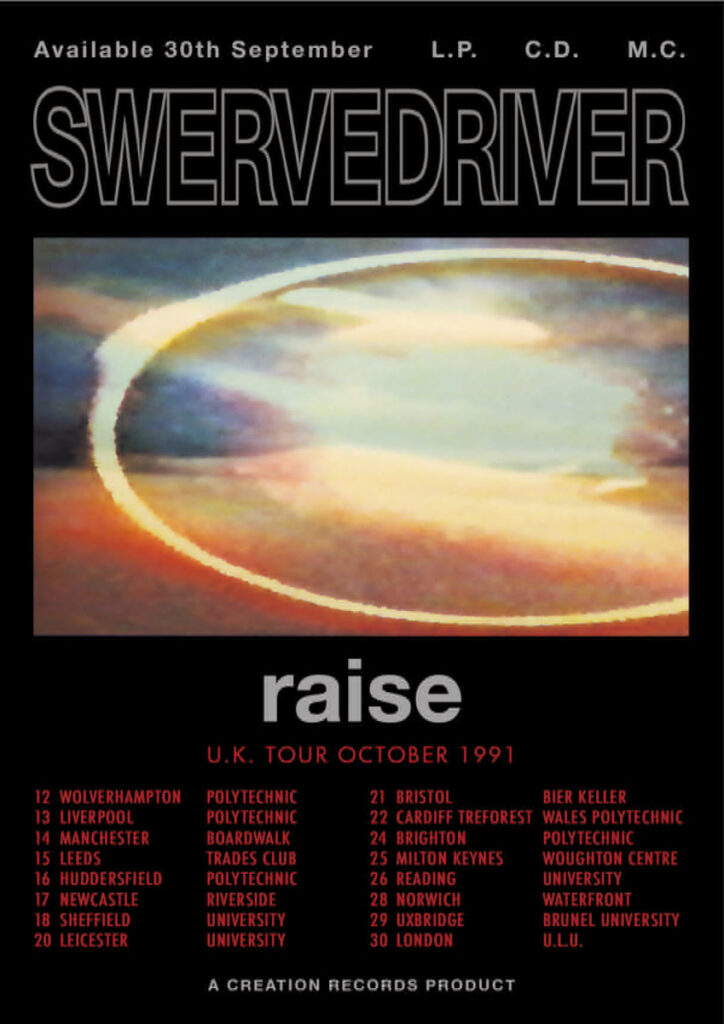
There’s a lot more to the story of ‘Raise’ and I’ll publish that later, but those are the tracks. I’m proud of a lot of the album and I’m glad that the appreciation of it seems to grow more over the years. On the sleeve notes of the 2008 reissue, Jimmy raised the question of whether it deserves a remix to bring it up to date, which is an interesting thing to ponder. One of the tracks that we recorded during these sessions was a song called ‘Hands’ which didn’t make the album once the decision had been made to include the previous singles but it was later mixed by Alan Moulder and appears on the ‘Never Lose That Feeling’ EP. The sonic quality of Alan’s mixes are excellent and it’s tempting to imagine the ‘Raise’ material presented in a similar way. But would that treatment ruin what the album already is? Albums, to me, are supposed to be a snapshot in time. A presentation of what a band’s abilities and ambitions are at a certain moment. If you take away what it was when it was made and force it to compete with whatever has come after- and on the terms of whatever is current- will its essential character be ruined? Will it cease to have the allure of being an artifact from another time? Will it become spoilt in the process? It’s an odd thing to think about and would be a difficult decision to make, so luckily for us we don’t have the funds to do it or the access to the tapes. So that puts an end to that. Speaking of funds, we are still waiting for the Ford Motor Company (who reintroduced the Mustang in 2005) to call and licence a certain track for marketing purposes. Maybe that windfall would free up some resources at last…