

If you nip up to Foyles on the Charing Cross Road and have a peruse of their impressive music department you can find a whole load of coffee table books dedicated to photographs of rare and valuable guitars. These will feature high quality reproductions of images of classic guitars with accompanying reverential text and will usually be big, heavy and expensive. So, in the spirit of that kind of thing (but free) here is the first in an occasional series of posts dedicated to guitars that I find interesting. Some of them may not be rare or old, while others may be considered by some to have no redeeming features whatsoever but they will all, for various reasons, have either worked their way into my affections or caught my eye at some point. I can’t guarantee that the photography will always measure up to the quality you find in the kind of heavyweight publications I mentioned earlier (honourable exceptions will be ones that I didn’t take) as my camera skills can be somewhat variable but I promise I’ll try my best.
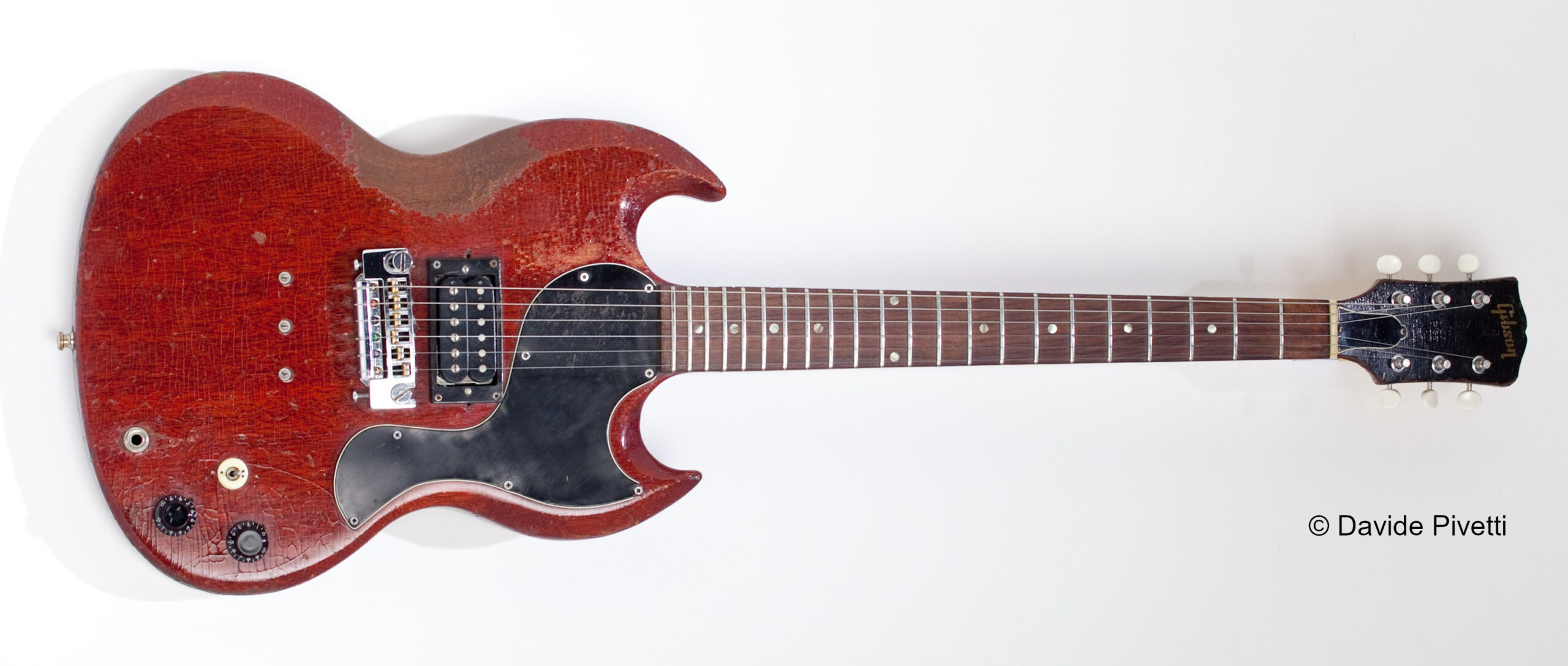
So, here’s the first example- a 1968 Gibson SG Junior. In a series of moves that will horrify vintage guitar purists, this one has been heavily modified. The original P90 pickup has been replaced by a humbucker of indeterminate origin and the former presence of the Vibrola tailpiece is betrayed by the three mounting screws that remain behind in the face of the body. The old bridge, with its intonation ridges cast into the surface has been swapped for a two piece Schaller wraparound bridge and tailpiece. This is a bit ungainly looking to be honest but as each saddle is fully intonatable it does make playing up the dusty end less of a teeth grinding experience, although the whole assembly looks like its become a bit out of alignment at the moment. Up at the headstock, the look of the reissue Kluson 3 Plate machine heads is correct and we can only assume that the action and feel of the originals had become too vague to guarantee accurate tuning, hence the replacement. The volume and tone knobs are also replacements and the pickup has also obviously been coil tapped at some point (but since disabled) and a switch for this added. Finally, the strap buttons have been replaced with Schaller locking types.
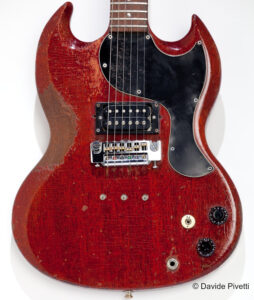 The most obvious feature of this guitar is the extensive amount of wear and tear. Its obviously loved and lost (like Frank has…) and proudly displays all the scars of combat it has gathered along the way. It has been worn down to the bare wood in several places on the front and rear and shows almost complete lacquer checking on every surface, including the headstock and rear of the neck. The screw holes for mounting the ‘dog ears’ of the original P90 are visible on either side of the pickup surround and the scratchplate is warped and bent. Anything else? Oh yes- the pickup bobbins and the surround have plenty of pits and scratches of their own.
I have to say, I think that this guitar looks fantastic. With the process of relicing guitars now approaching a fine art its good to see that every scratch and bump on this one is 100% genuine and has been gained from either using the instrument for the purpose that it was intended or genuine neglect. Or a combination of both most likely. It has certainly got tons of gnarly, grizzled charm and always attracted plenty of attention from guitar enthusiasts.
This guitar was, for a number of years, the main instrument of guitarist, songwriter and solo artist Charlotte Hatherley and it was one of a number of instruments that I was responsible for when I had the pleasure of being her guitar tech on numerous tours earlier this century. I always enjoyed strapping this instrument on, the neck has a slim profile (which I’ve always preferred despite having big hands) and a rosewood finger board which is my favourite combination. Being a Jr model, there is no binding on the neck and I suspected that it had been refretted at some point prior to my introduction to the instrument, as the frets seemed to be a little too wide to be vintage correct. But they had been stoned nice and low so the guitar was comfortable and easy to play. Plugged into a high gain valve head (initially a Marshall 6100 but was later superseded by the Ashdown Fallen Angel) the instrument really came to life, loads of natural sustain and great balance, plenty of warm chug for dampened chords but it opened up nicely for full rhythm stuff- every note in a chord ringing through with no harshness on the top end at all. Single note leads would still cut through nicely as well and feedback notes would easily bloom and be held without fading. Admittedly I had to form an opinion about the latter from hearing someone else play as I’m a rubbish lead player, but judging from the way the guitar performed with my limited skills its a very accurate assessment.

I’m always impressed by the amount of abuse that SGs can take, the thin bodies and double cutaways always lead me to think that they are quite delicate when I put one on, but obviously this example is absolute proof that they can take a huge amount of punishment and still be able to dish it out. With its great sound and confirmed provenance, I have a huge amount of affection for this guitar and as it is no longer able to be seen live in Ms Hatherley’s fair hands its good to be able to pay tribute to it. More photos of this guitar can be found here.
Many thanks go to Charlotte for arranging the photos and to Davide Pivetti for taking them.