

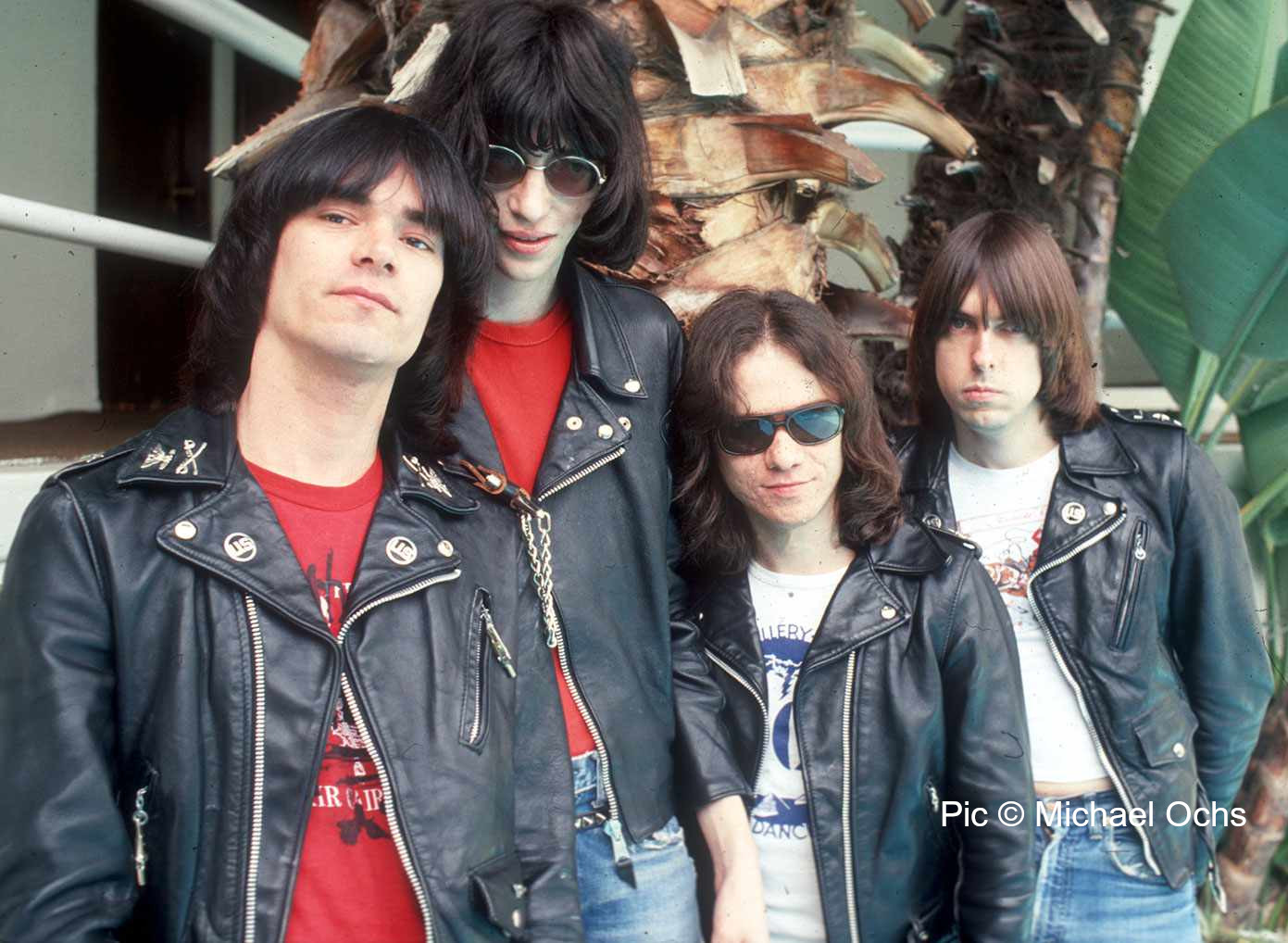
Note- This profile of Johnny Ramone was originally commissioned by Guitar & Bass magazine and was printed in the July 2010 issue. It is republished here in its entirety, without the unintentional cut made by the sub-editor that ruined the final paragraph.
The story of the Ramones is the story of a band who were arguably one of the greatest bands of all time. When they emerged onto a shocked and stunned New York music scene in 1974, it was the beginning of a long career that would bring the band much critical acclaim, win them an enormous cult following and influence at least three generations of musicians. Despite these achievements, the band were unable to make a serious commercial breakthrough and after thousands of live gigs and 18 albums they eventually split in 1996. Through 22 years of adversity they were lead by the determination and self belief of the man on stage right- the late, great Johnny Ramone, probably the most ferocious rhythm guitarist in history.
The Ramones hailed from the quiet New York suburb of Forest Hills, across the East River away from the bustle of Manhattan. As a teenager Johnny was a committed music fan, early rock ‘n’ roll and British beat groups being his particular favourites. However, what brought him and his band mates together was a love of harder, tougher sounds- The Stooges, Alice Cooper and the MC5 as well as local heroes The New York Dolls. The latter’s lack of musical dexterity had a particular impact “The Dolls were such an influence” he said “We saw them and realized that they were a great band but they didn’t play well at all”
Taking their cue from the Doll’s attitude and energy the Ramones- Johnny, vocalist Joey, bassist Dee Dee and drummer Tommy- began rehearsing and immediately eschewed covering songs by other artists “We tried to figure out other people’s songs at the first rehearsals but we couldn’t because we had just started to play” he explained “So we decided to write our own songs. We wrote ‘I Don’t Wanna Walk Around With You’ the first day”.
When the band emerged to play their first gigs at downtown dive bar CBGB’s they sounded not only unlike any band in New York but also not like any other band on the planet. It was a sound that had nothing to do with stagnant arena rock posturing, vapid disco music or rootsy funk. It was raw, noisy and simplistic and it was played at a reckless pace. What is wasn’t was stupid or totally without precedent as it was plugged straight into the linage of classic American music- 50’s rock ‘n’ roll, doo wop, surf music and 60’s pop- but delivered in a fierce wall of distortion and bereft of superfluous indulgences like solos, subtlety or deviation. The songs were short, most clocked in at under two minutes and for all its ferocity it wasn’t angry music, on the contrary the Ramones were fun. The band’s friend and colleague Arturo Vega said “People would laugh. When you first saw the Ramones, you had to laugh. It was shocking but in a funny way. What the hell is this? What are these guys doing? But the energy was undeniable”.
Although the majority of the songs on the first three Ramones albums were written by Joey and Dee Dee, what defined the Ramones more than anything, possibly even more than the matching uniform of leather jackets, ripped jeans and tennis shoes, was the unrelenting guitar assault of Johnny Ramone. After realizing that the shortcut to being able to play chord progressions was to use the humble barre chord, he developed and very quickly perfected a style that involved combining these with fast downward strumming and huge amounts of overdrive. It was a revolutionary reduction of the art of the guitarist, stripped right back to its absolute bare essentials and it worked to devastating effect. The apparent simplicity of this technique was deceptive as moving barre chords with any kind of fluidity or precision is a lot harder than it looks, especially at speed. The key, according to Johnny, was to develop what he called a ‘limp wrist action’. “Other people try to play like the Ramones and don’t sound the same because they play with their arms” he explained “But I didn’t play guitar until I learned with the Ramones, basically counting a downstrum ‘one-two-three-four’ all downstroke and barre chords. I just learned to play by the numbers”. Producer Ed Stasium, who worked on many of the band’s albums and is no mean guitarist himself, goes further “Johnny makes it sound simple but I can’t do it and I bet Eddie Van Halen can’t, not for an hour (at a time). No one else can do what Johnny Ramone does”.
 By 1976 the music business had got over the initial shock of the Ramones and began to realise that they had serious potential. Sire Records quickly signed the band and released three classic albums in only eighteen months (the self titled debut in 1976 and both ‘Leave Home’ and ‘Rocket to Russia’ in 1977) each of which refined the distinctive wall of powerchords sound a little further. It also became clear that not only was Johnny providing the band’s sonic signature but was acting as its driving force too. “It was Johnny’s band“ says a former manager “Johnny was the disciplinarian, there was no question about that…he’d punch Dee Dee in the head after a show if he’d messed up”. Tour manager Monte Melnick agrees “Johnny was right on the ball. He knew how to run that organisation, making sure the group had certain rules and stuck with them” These rules extended to live performances, which were already a breathless experience for an audience. The band would play tight and fast, the short pauses between songs were only long enough for bassist Dee Dee to shout his trademark “1-2-3-4” intro count before the next song started. Johnny would insist on more though, band members were forbidden to face away from the audience or communicate with each other, all the energy had to be sent outwards toward the people at all times. “We loved rock ‘n’ roll, we looked at all the great things about it and tried to learn from it. We knew we were following in its footsteps” he said “We knew we had to get up there and do a professional show and how important image and charisma was, how you stood onstage, how you walked onstage. Every little piece would become important”. These were rules that the band were still obeying right to the very end and even after the band went into retirement and right up to his death from cancer in 2004 Johnny remained true to the spirit of the Ramones, his distinctive bowl haircut never changed and when the band were inducted into the Rock ‘n’ Roll Hall of Fame in 2002 he was the only member still sporting a black leather jacket.
Up until the emergence of speed metal in the 1980s no-one played harder and faster than the Ramones (except perhaps Motorhead, but Lemmy was a confirmed Ramones fan anyway) and the band can claim credit for being an influence on some of the prime movers of that movement, Johnny in particular becoming good friends with Kirk Hammett of Metallica. They were also the catalyst for the first wave of UK punk bands and everyone from Bruce Springsteen to the Red Hot Chili Peppers have declared themselves fans. Their influence on the likes of Green Day or Blink 182 is so obvious it possibly does not have to be pointed out.
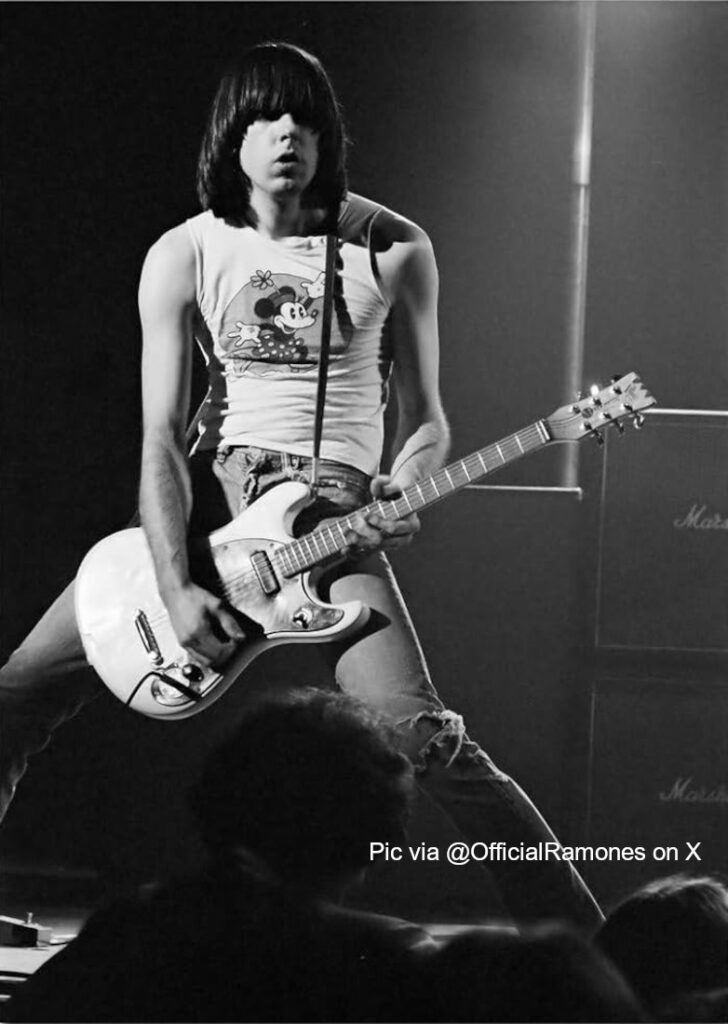
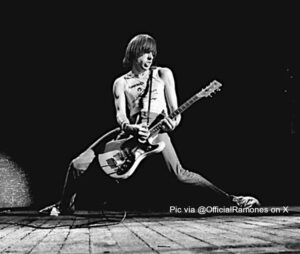
Every rock & roll generation needs to remember why it picked up a guitar in the first place and whether it has been through one of the band’s classic albums or a live shot of Johnny Ramone with low slung guitar, leather jacket and a wall of Marshall cabinets, the Ramones have provided a reminder of rock ‘n’ roll the way it was meant to be played- loud, fast and with total commitment.
Catalogue highlights.
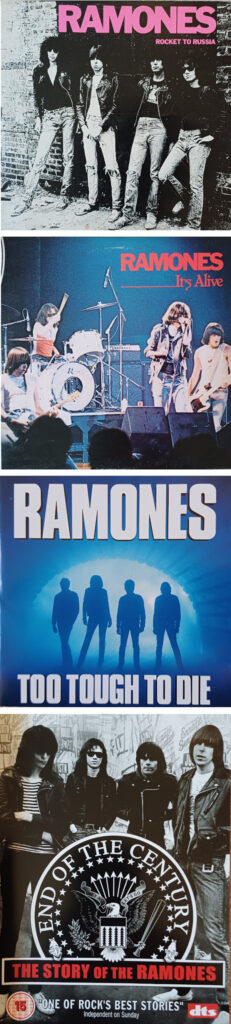
Of the first three albums, the 1976 self titled debut may have been the one that attracted admiration and derision in equal measure and subsequently inspire a generation of punk bands, the follow up, ‘Leave Home’ was just as strong and contains the track ‘Pinhead’ which spawned the band’s “Gabba Gabba Hey!” catchphrase. However ‘Rocket To Russia’ (1977) was Johnny’s favourite. With the band’s style now refined and perfected it contains two bona fide Ramones classics- ‘Rockaway Beach’ and ‘Sheena Is A Punk Rocker’- as well as a number of other fan favourites including ‘Cretin Hop’ and ‘Teenage Lobotomy’.
Versions of all these songs would also appear on the 1979 live album ‘Its Alive’, which was recorded at London’s Rainbow Theatre on New Year’s Eve 1977 and showcases the original line up in gobsmacking form. Containing highlights from the first three albums and clocking in at 28 songs in just 53 minutes, it was the last album to feature drummer Tommy Ramone, who was replaced by former Voidoids sticksman Mark Bell (AKA Marky Ramone) in 1978. Tommy would return to the band, but this time in the producer’s chair, for 1984’s ‘Too Tough To Die’ which was an excellent return to form after the variable output of the early 80s. Dee Dee’s songs and vocals bring a hardcore punk edge to this album and the guitars are crunchier than ever. It is worth seeking out their appearance on the BBC music show The Old Grey Whistle Test from around this time, as it features great versions of three songs from this record.
Considering the legend that has grown up around the band, it is perhaps surprising that it took until 2004 for an authorised biopic to finally emerge and when it did some uncomfortable truths were uncovered. While Dee Dee’s problems with drugs had previously been an open secret, the personal animosities between some of the members came as a shock and the band’s continual frustration and final disillusion due to their lack of commercial success is sad to see. Despite this, the film is crucial viewing and an invaluable source of much archive footage, that also features rare interviews and other extras and is made even more poignant by the fact that both Joey and Dee Dee had already passed away by the time of its release and Johnny would succumb to cancer not long after.
Gear
Although photos exist of Johnny Ramone playing Rickenbackers, Hamers and Fenders, he will forever be associated with his white Mosrite. “I wanted to play a guitar no-one was playing, something I could be identified with” he said. All Johnny’s Mosrites were slab body Ventures II models, although the first one, which was stolen early in the band’s career, was blue and featured the Moseley vibrato (which he never used). This guitar can be seen in many early photos of the band live.
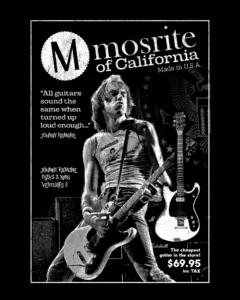 Its replacement was the famous white guitar which Johnny played right up to the end of his career. Now owned by producer Daniel Ray, this guitar had a bridge/tailpiece combination instead of the vibrato and was modified by substituting the original Kluson tuners for sturdier Grovers as well as changing the bridge pickup to a high output single coil, the DiMarzio FS-1. A Seymour Duncan mini humbucker was later added to the neck position.
In 1989 Mosrite introduced a Johnny Ramone signature replica but these are now discontinued. Expect to pay many thousands for a genuine example with Johnny’s signature.
A key element to the Ramones guitar sound is volume and Johnny was a Marshall user for virtually his whole career. From 1975 through to the early 1980s, 1959 SLP ‘Plexis’ and non-master volume JTMs were his preferred choice but after their equipment was stolen for the second time in 1983, the band adopted the JCM800 version of the 2203. All heads were 100 watts and powered Marshall cabinets containing Celestion Greenback speakers. Johnny used no FX but kept an A/B box in line to use as a mute.