

During September 2018, I was invited to participate in Classic Album Sunday’s upcoming celebration of Sonic Youth’s ‘Daydream Nation’. This was to take place in the form of a full album playback and talk by myself and other guests at Portsmouth’s excellent Pie & Vinyl record shop. Having been given advance notice of the topics planned for discussion, below is some of the thoughts and notes I made as part of the preparation for this event.
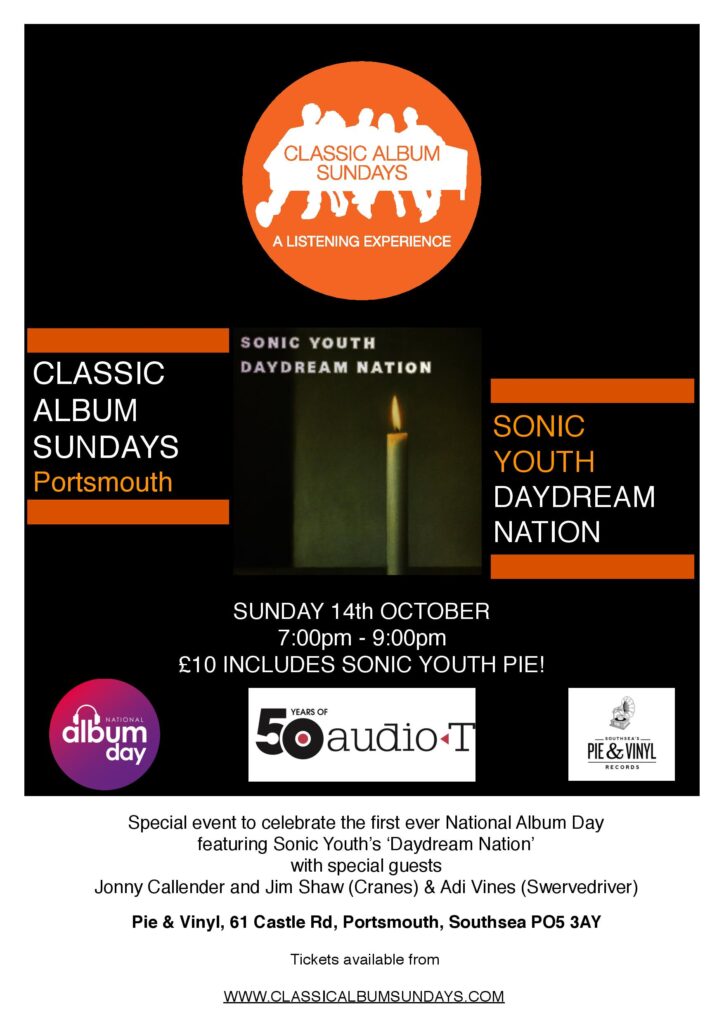
Q-Personal Stories and experiences of Sonic Youth.
‘Bad Moon Rising’ was the first Sonic Youth record I heard but I can’t remember exactly when I first heard it. I was interested but not sure if I liked it, as it was a challenging listen. ‘EVOL’ was easier to get into as it was more coherent and once I’d absorbed that it was easier to go back to ‘Bad Moon Rising’ and appreciate it. Then ‘Sister’ came out and that was a big indie hit- even though I thought it was a bit messy- and I got the first chance to see Sonic Youth live.
There was a week of gigs at the Mean Fiddler in Harlesden, that were curated by Blast First who were Sonic Youth’s UK record label. Each night featured two or three bands that were on the label. Dinosaur Jr headlined one of the nights and Sonic Youth headlined another. All of the members of my band at the time went to both. We all piled into a car that our drummer had borrowed from his parents and drove up from Oxford. It’s the middle of summer, its hot and the venue is small and absolutely packed and it probably rates as one of the best gigs I’ve ever seen. The band were incredible, really loud, even up on the balcony where we had to sit because our guitarist’s girlfriend wasn’t very tall so she could never see anything if we watched from the floor. I went downstairs however after a couple of songs, and arrived near the stage just as the band launched into ‘Tom Violence’ which was- and still is- my favourite Sonic Youth song. If you are familiar with it, there is a middle section where it breaks down and then gradually builds again. At the moment when the whole band came back in- maybe because it was so loud or maybe because there was some kind of shared energy with everyone in the room- the adrenaline rush I got almost knocked me out. I felt excited and nauseous at the same time, a full physical reaction almost like a simultaneous orgasm and a faint. I’d never had a reaction like that before, or since. The other detail I remember from that night was Thurston Moore’s stripey t-shirt, which I thought was ultra geeky and made him look like a member of a Sarah Records band. That was probably intentional.
I never met any of Sonic Youth, not even when Swervedriver had their modest 15 minutes of fame. I did come into their orbit in a peripheral way, ie being in the same room as them at times and passing them in corridors and so on but we never met. I almost had a moment of saying hello to Kim Gordon once though. It was about a week or so after they had headlined the Reading Festival in 1991, which we had also played at as well as hanging around for the whole weekend and so we had been around them. I was in New York and was just about to go into Canal Street Jeans and as I was going in through the door, Kim Gordon was coming out. I probably did a double take and she saw me too and a confused look came over her face for a split second. Then we were both gone- I couldn’t tell whether she kind of thought I looked familiar but couldn’t place who I was or she recognised who I was and was trying to work out whether I was cool enough to say hello to or not. But she didn’t acknowledge me and I perversely hope it was because of the latter as that would have been in keeping with their tastemaker reputation and I can add it to the list of celebrities that I’ve been insulted by.
Q- What the album ‘Daydream Nation’ means to you.
I’ve been listening to and collecting music since I was 13 and in those 40 years there are only three albums that were important enough to me for me to own on multiple formats- ‘Exile On Main Street’ by the Rolling Stones, ‘Raw Power’ by Iggy & The Stooges and ‘Daydream Nation’.
 It had a massive impact on us as a band when it came out in 1988. ‘Daydream Nation’ and ‘You’re Living All over Me’ by Dinosaur Jr were the two albums that changed our musical direction. I had found the mid-1980s to be a pretty desolate period for new music. The best of the post-punk bands had either disappeared or were in decline and there was nothing else that had come around to fill that gap they had left. To be honest, apart from my old favourites, I spent most of the mid 80’s listening to Hawkwind and thrash metal. Swervedriver were still called Shake Appeal at that point and as the name might suggest, we were an homage to the Stooges and the MC5 and well as being in thrall to 60’s garage punk. We had very little interest in contemporary music but the exceptions were the Jesus & Mary Chain and Husker Du and slightly later, Spacemen 3 and Loop.
I can’t actually remember exactly the first time I heard Sonic Youth but it was probably around late 1986. I do remember that it was ‘Bad Moon Rising’. There is a track on that album that is a cut-up of the Stooges ‘Not Right’ so that was the first thing about it that made me prick up my ears. However, due to the experimental nature of it, it took me a long time to learn how to appreciate it.
I grew more and more interested in the band as ‘EVOL’ and ‘Sister’ came out but it was ‘Daydream Nation’ that really blew me away. It was like all the best bits of the previous albums refined and then blown up to massive proportions. There was so much to take in musically, lyrically and conceptually.
You can discuss its meanings for hours, and that is interesting in itself, but for me it was all about the guitars. The band’s style had been pretty well established over the preceding albums but listening to the guitars chase, twist and spin around each other on ‘Daydream Nation’ is totally enthralling. They are sometimes ugly and discordant and at others delicate and beautiful. Sometimes they don’t even sound like guitars at all- I can hear bells, sirens, the clanking, humming and throbbing of industrial machinery as well as subway trains, jet aircraft, raindrops, fax machines, explosions, electric drills and more. Its really quite astonishing.
‘Daydream Nation’ forced me into a total re-assessment of the potential of the electric guitar and it made me question what was acceptable musically and harmonically within the structure of a rock song. I’d always been interested in unusual guitarists- Andy Gill from Gang Of Four, Geordie Walker from Killing Joke, Keith Levine from Public Image and John McGeoch from the Banshees and Magazine, all who had used dissonance in their style but ‘Daydream Nation’ just took things to an extreme, but in a way kept it coherent and accessible. From a conventional viewpoint there are great songs, wonderful hooks and melodies and ever shifting moods, which is difficult enough to achieve within a standard musical format, without adding in radical guitar techniques.
After hearing this, we stopped being a conventional rock band overnight. Up until that point we were all standard riffs and powerchords and ‘Daydream Nation’ was a large part of showing us another way forward, a way to still be abrasive and powerful but also be a little more adventurous and expansive.
I certainly think that without ‘Daydream Nation’ I wouldn’t have been able to appreciate My Bloody Valentine’s ‘Isn’t Anything’ which came out about a month later. So, in a way I think it reprogrammed my brain into being more receptive.
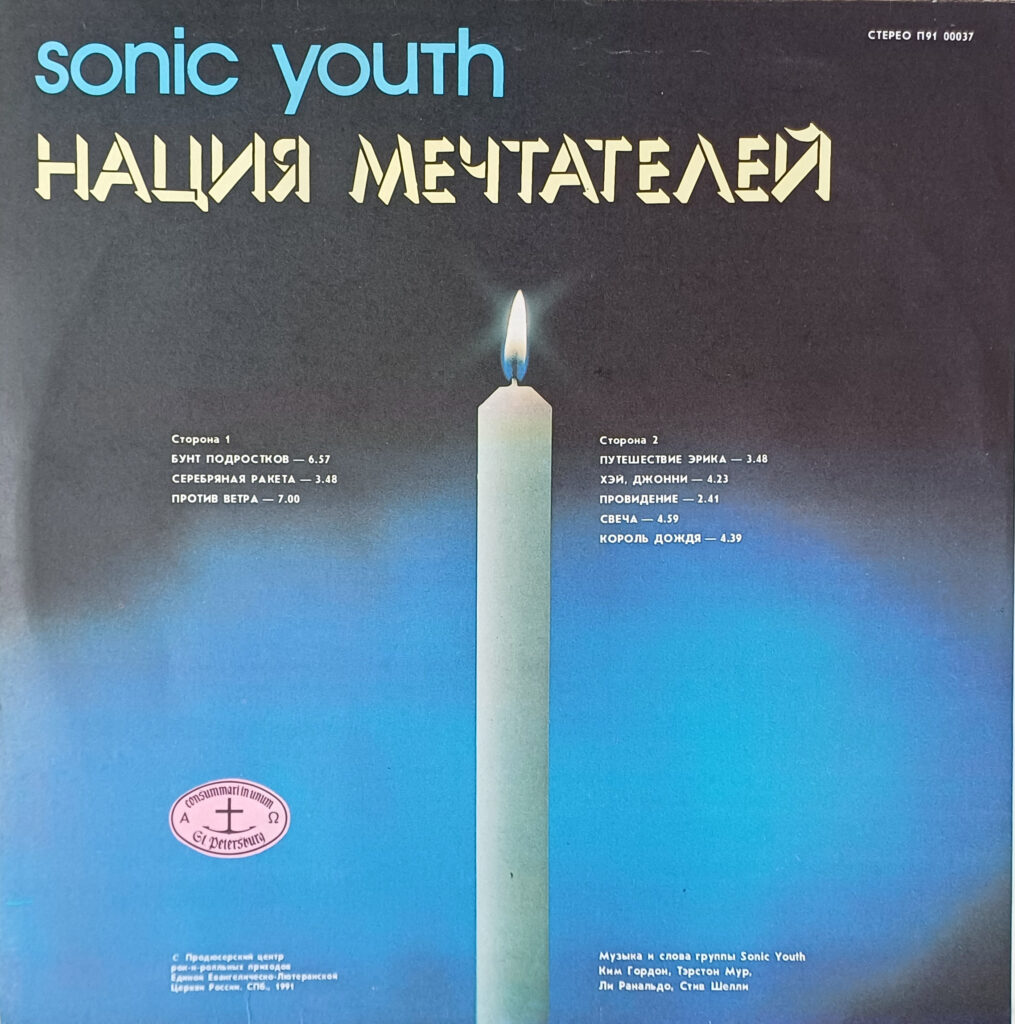
My latest version of it is a Russian bootleg of ‘selections from Daydream Nation’ (which is referred to in the ‘Daydream Nation’ box set sleeve notes) that I found in a record shop in Poland. Whoever was responsible had no quarms about bootlegging the audio tracks but balked at recreating the album cover.
Q- Start of the grunge movement? Minutemen, Husker Du and Sonic Youth? Art punk?
Ah, grunge. The only other description as reviled as shoegazing. Were Sonic Youth part of the start of it? No, not really. Grunge to me has it’s roots in classic heavy rock- Sabbath, Blue Cheer, Deep Purple and so on. In fact, there is a great series of compilation albums called ‘Brown Acid’ out at the moment that features loads of obscure and unknown rock bands from the early 70’s, any of those, with a modern production job, could easily pass for a 90’s grunge band. What became popularly categorised as grunge were all those awful bands like Pearl Jam, Stone Temple Pilots and Alice In Chains and they just sounded like shit 80’s metal bands to me. I don’t see what any of those had in common with the 80’s US underground. So, to associate them with anything on SST Records, Homestead, Twin Tone or Amphetamine Reptile or any of those labels is completely wrong.
As for ‘art punk’- is there such a thing? A lot of the post-punk from the late 70’s onward was inspired by and referenced literature, film and philosophy and I think that is true of a lot of music. Art has always inspired and has been appropriated by other art. Look at the adoption of situationist rhetoric in 70’s UK punk. There has always been art involved, so to call something ‘art punk’ is stating the obvious a bit and a pretty redundant term.
Q- Is ‘Daydream Nation’ a political album for the Reagan era?
Not directly, I don’t think. I don’t hear the band addressing big political issues and if they did, I’m sure that they would have been approached in a pretty oblique way. So, with that in mind, maybe they actually have and I just haven’t noticed.
I think that with some imagination you could probably link some of the themes on ‘Daydream Nation’ to the policies of the Reagan administration- ‘Hyperstation’s description of inner city decay and tension or ‘Teenage Riot’s yearning for a youth led political elite, for example. In fact, you could interpret the album’s title as a political statement if you want- is the nation busy daydreaming while a cruel administration creates havoc with the country? Or is the country fully aware and is busy daydreaming about what will lift them out of it instead of confronting the issues? Just about everything lyrically on the album is open to interpretation and perhaps that is the intention, to provoke conjecture and to confuse.
If it is intentionally political in any way it is probably in the reflection of American society at the point it was recorded. Issues dealt with include crime, sexual harassment, urban malaise, the death of US industry and drugs- and that’s just the ones I can make out. But then its also about science fiction, pop art and rock ‘n’ roll so who can say for certain, apart from the band themselves?
Q- Nick Sansano’s production?
Well, use of the word production seems to imply a responsibility for delivering a finished work and being involved in the artistic as well as the technical process of creating and recording something. I’m pretty sure that was not Nick Sansano’s role. He was the engineer, which involves overseeing the technical process but not necessarily contributing any ideas (although that may be entirely possible, too).
There is not actually a lot of ‘production’ evident on the album. There doesn’t seem to be a great deal of electronic processing on any of the instruments, in fact it’s a very dry and live sounding record. If you listen to the live versions of the songs that come on the extra discs on the box set, the sound of the band in concert is pretty close to the sound of the band on the record.
Its undeniable that it’s a much more coherent sounding record than any of the other albums. From track to track, the tone and levels of the instruments don’t seem to change much. However, if you compare the balance of the instruments to what is a generally accepted as a ‘rock’ mix, then its pretty poor- the drums have no real presence or attack and the bass is mostly indistinct and frequently inaudible. That’s OK for me though (even as a former bassist) as it puts the focus firmly on the guitars and that is what the album is all about for me. I’m pretty sure that delivering a ‘generally accepted rock mix’ wouldn’t have been high on the band’s list of priorities anyway.
Possible points to reference during discussion (to be worked on before inclusion).
I was living in Oxford when ‘Daydream Nation ‘ was released and due to the high turnover of housing in the city, I was moving quite frequently. As a box of cassettes was lighter and easier to move than a box of vinyl (and you could get more cassettes in the same size box) I owned much of my music on cassette and that included ‘Daydream Nation’. But I liked it so much and it was on Blast First, which was a cool label in the UK, so I bought it on vinyl too, although it didn’t actually get played until I bought a turntable in 1992.
Perhaps discuss other formats too- CD (1990/91?) download, box set, minidisc & US Enigma pressing? The concert film?
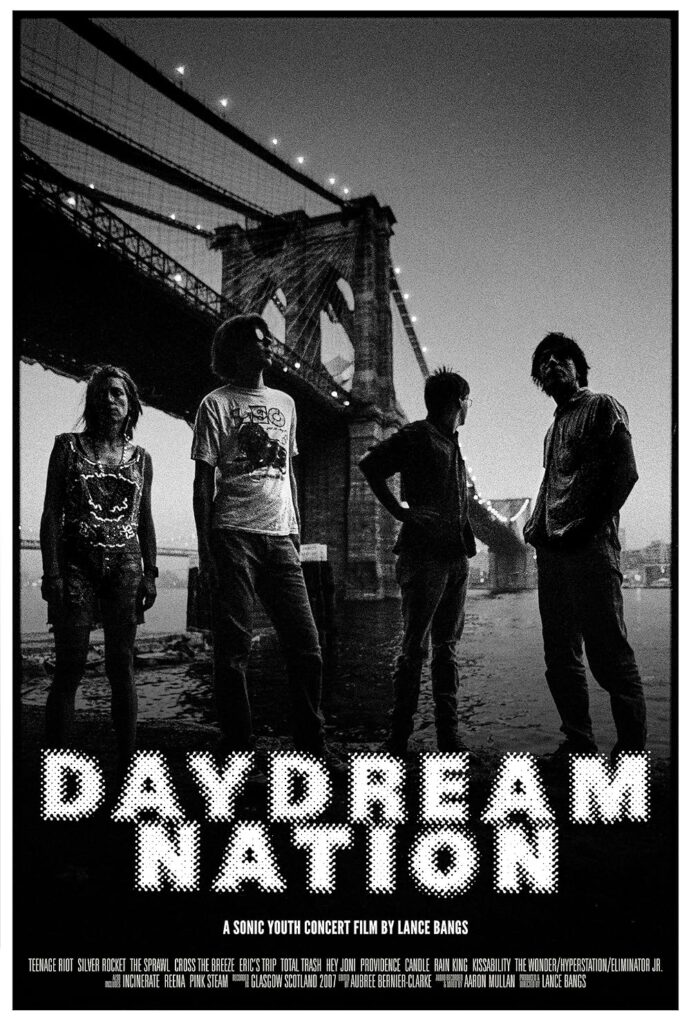
Mention early interest in Sonic Youth- they referenced the Stooges, punk and pop culture, so if you were interested in noisy underground music and guitars there was no way you couldn’t be curious.
Discuss ‘Daydream Nation’ musically as its undoubtably the band at their height. It was a double album which not long before would have been scorned as prog rock indulgence. But the amount of material on ‘Daydream Nation’ needed more than one disc. On reflection, considering the nature of some of the material and its experimental nature, perhaps it is a kind of prog rock and so is perhaps perfectly apt that it’s a double album, an irony that I’m sure the band were fully aware of. Is it a Sci-Fi concept album? (refer to ‘The Sprawl’ and the mention of ‘jacking in’ and possible links to William Gibson’s ‘Neuromancer’ etc).
‘Daydream Nation ’guitars. There had been similar guitar experiments before but had been very left field arty concepts (refer to Branca’s symphonies). ‘Daydream Nation’ put this approach and these ideas into a successful set of rock songs for the first time. And what great songs they are with great riffs, different atmospheres etc. Quote some examples- ‘Rain King- tense and threatening’ and ‘Hyperstation- weary and resigned’ and ‘Total Trash- playful and trite’ and everywhere in between.
Is it a ‘New York album’? Perhaps- clamour, confusion and constant rush.
Great lyrical imagery on ‘Teenage Riot’- a premonition of the alternative nation?