

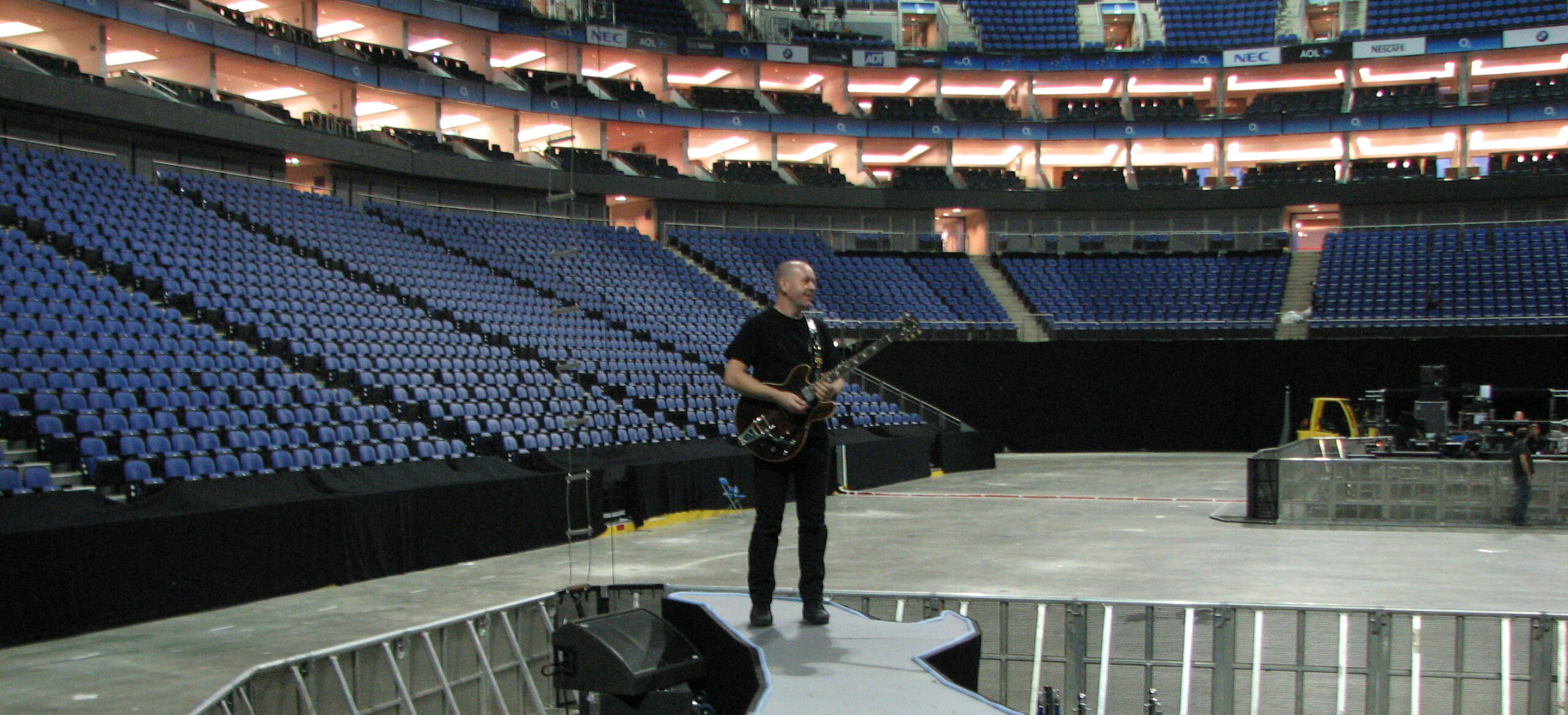
Another article originally commissioned by Guitar & Bass Magazine. Reproduced here slightly updated, with the somewhat tongue-in-cheek ‘Day In The Life…’ sidebar included and with all of the text reinstated that had to be edited out of the original piece because of space restrictions. The tone of it is deliberately lightweight, due to the target market, but I think much of it still stands up. Besides, we don’t want to give ALL the secrets away, do we?
Being a pillar of society in my local area, I am often invited to lavish dinner parties at the manor on the hill. At some point, usually over canapés and expensive wines, one of the devastatingly beautiful guests will ask what I do for a living and I will clench my teeth as I explain, waiting for the inevitable. The ‘R’ word- roadie- comes up eventually, although it never passes my lips. This is not because it is an occupation to be ashamed of, in fact at its higher levels it is an extremely skilled, sometimes difficult job and positions are highly contested. But partly due to the music industry’s reputation as a refuge for drunks and wasters of various persuasions, partly due to lurid on-the-road accounts like the notorious Led Zeppelin expose ‘Hammer Of The Gods’ and partly because there is no formal qualification for the job, it is sometimes unfortunately perceived to be more like casual labour rather than an admirable career choice. In a recent interview with the BBC, a member of the Glastonbury festival production team commented “…unfortunately, you can’t use the word ‘roadie’ without it being pejorative, it’s a term of abuse”. Nice use of the word pejorative, he’s obviously no flightcase pushing dimwit. However, the clichéd view of a ‘roadie’ as a silk tour jacket wearing, skirt chasing beer monster is all too prevalent and is, these days, pretty far from the truth. Your local luthier or amp repair specialist doesn’t have a reputation for being an unemployable loser so why should the ‘roadie’- who uses the same skills but does his job in a different town every night- suffer such a bad rep? So, I’m going to attempt to write some wrongs, starting with this ‘R’ word business.
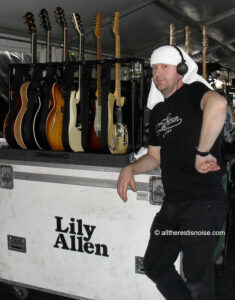 The Online Etymology Dictionary defines a roadie as a ‘labourer employed by pop bands while on tour’. A rather archaic and vague description that seems to suggest that lighting technicians, wardrobe persons, caterers and sound engineers are, if not one and the same person, at the very least capable of taking up each other’s duties. So, by this definition a ‘roadie’ is merely someone who performs their work on a concert tour. Unfortunately, this does not tell us anything about what any of these people actually do. Hence, I always describe myself as a guitar technician, as my chosen area of specialisation is guitars and their associated amps & FX. I used to use the phrase ‘backline technician’ but I stopped for two reasons, firstly hardly anyone outside the industry knew what backline meant so I ended up explaining about guitars anyway and secondly, I know very little about drums and even less about keyboards so it seemed a little dishonest.
FAQ 1- How did you become a guitar technician?
It started in the late 1980’s when I moved from my home town to Oxford. To make ends meet I took a casual job at the Apollo Theatre, humping gear around on gig days. I then got involved with a couple of local bands, doing the same thing for them. I took a year off from that when, through a government training scheme, I found a placement at a guitar workshop and it was there that I learned all the repair and maintenance skills. I picked up the touring work again after that and it just built up from there.
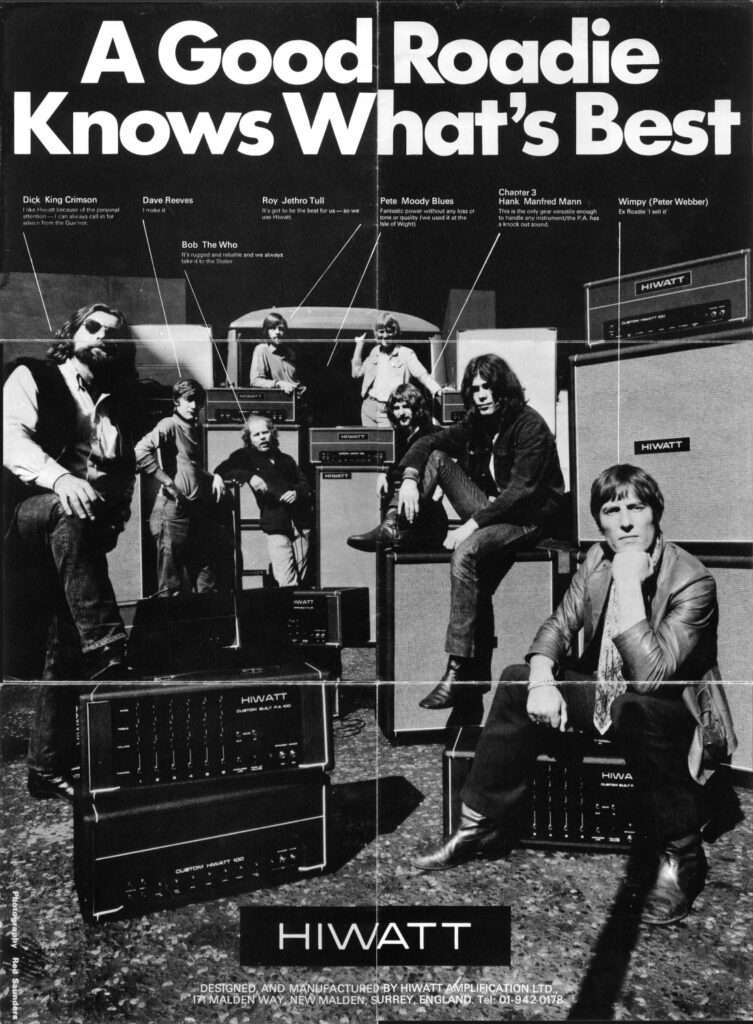
Like many things, we can blame the 1960s for giving us both the phrase ‘roadie’ and the species. The days when touring bands would turn up at a provincial Gaumont cinema and be plugged into the house speaker system by some Ealing comedy jobsworth (usually an ex-infantry sergeant or similar) were giving way to what would soon be recognizable as a modern rock show. Artists like the Who were driving the need for bigger (i.e. louder) sound systems and you don’t think Jimi Hendrix carried all those Marshall cabinets up the stairs himself do you? Research for this article has brought up surprisingly little information on the early days of touring as we know it and, with a few exceptions, barely none of the names of the persons involved. But we do know that bands have always had was used to be known as helpers. The Rolling Stones had Ian Stewart (whom they had, sometime in 1963, demoted from full band member to assistant and side musician) and the Beatles had Mal Evans but for the first mention of anyone being employed by touring musicians purely for their technical skills, we have to return to Hendrix again. In 1967 he met an expert in vibration and acoustic research by the name of Roger Mayer who, in time off from his day job at the laboratories of the British Admiralty, built electronic devices for his guitarist friends like Big Jim Sullivan, Jeff Beck and Jimmy Page. Within a fortnight of this meeting, Mayer was in the studio with Hendrix and toured with him throughout 1967/68 although we can be pretty sure that he wasn’t restringing Strats while waiting for his soldering iron to warm up. The roadcrew breed did exist in recognizable form around this time though and was sufficiently defined enough for amp manufacturers Hiwatt to get some of the more notable figures together for a publicity shoot.
In their book ‘How Black Was Our Sabbath’ published in 2004, former Black Sabbath crew members David Tangye and Graham Wright refer to a new employee of the band, taken on in autumn of 1968, as an ‘old school roadie’ and although we have to assume they are applying the term in retrospect, his day to day responsibilities apparently included the following.
“… all the driving and running about, he made sure the van was properly serviced and he ensured that the equipment was in working order. He made their travel arrangements, set the gear up onstage and acted as a minder too…he took the flak and willingly acted as a general dogsbody.”
This is the classic perception of a ‘roadie’ and this type of person still exists today, usually working with musicians on a more grassroots level. He (and it is invariably a male, even in these more enlightened times, there are still very few female backline technicians) is usually a friend of the band and has been helping them out since their early days. His loyalty and work ethic are to be saluted as is his ability to exist on hardly any sleep. On this level, little has changed since 1968. So, what HAS changed in the touring world between then and now that has brought us to a point where travel arrangements, driving and minder duties are handled respectively by the tour manager, truck driver and security and the equipment (working or otherwise) is the sole responsibility of the technician? Again, hard evidence is difficult to come by but it is safe to assume that as the great blues/rock bands of the 1960s became the stadium superstars of the 1970s, the technical demands rose accordingly and the amount and complexity of equipment such as backline and sound systems led to increased specialisation by roadcrew members. Outside contractors such as PA or lighting companies with their own teams of technicians began to appear and by the turn of the decade the spectacle of musicians tuning up with pitch pipes in a crowded dressing room as seen, with dire consequences, in the film ‘The Stones in the Park’ was long gone.
FAQ 2- What does your job entail?
Put simply, travelling around the world on concert tours looking after the instruments and stuff that the artist uses onstage. This involves the obvious things like the daily re-stringing and tuning of guitars, as well as instrument set ups and modifications (and the occasional repair), building and maintaining FX systems, maintaining amps and cabinets and all their related cabling and so on, liasing with musicians about sounds, gig procedures and just about everything to do with their onstage performance apart from what they are going to wear! There is a lot of behind the scenes stuff too, which can include things as mundane as transport logistics or elements of accountancy- which is pretty far removed from changing pickups.
Today, the concert industry must be one of the last great unregulated industries. Although health and safety regulations are quite rightly beginning to make their presence felt, you can forget things such as minimum wage, overtime rates, paid holidays and a 40 hour working week. Such restrictions would quickly make tours financially unviable, because of the number of hours of manual labour each member of a roadcrew has to put in to ensure that the show goes on. Even the backline crew, the members of whom- along with their equipment- are usually the last in the building and the first out, will find a 12 or 14 hour working day not uncommon. That’s even if you can get into the industry in the first place, because for the guitar technician, up until fairly recently, there was no formal way of finding work, no-one advertised vacancies, there are no agencies and the whole system relies on good, old fashioned word of mouth. This has changed a little with the arrival of social media, as industry groups now exist where positions are occasionally offered, but still, your reputation is all and a good reputation is usually made by being out there doing it, month after month, year upon year, until the lucky breaks happen. It’s a Catch 22 situation though, you won’t get a good reputation until you’ve been doing it for a while and you can’t really get to do it without a good reputation. So, how are newcomers supposed to break in? Well, people still come into the job through the traditional routes, the ‘local crew’ path I took (see above) being common but some are failed musicians who are faced with the uncomfortable fact that they are unemployable in any other industry and as such you can frequently encounter members of long defunct semi successful bands working as touring technicians. Many others come into the job with nothing more than a driving licence and some free time. As mentioned earlier, lots of up and coming artists have at least one crew member who is a friend of the band and has been there since the beginning. This person can often face a pretty steep learning curve. The type of media saturation that is prevalent these days means that the success of an artist can sometimes be pretty rapid and this can easily leave the newcomer without time to learn the ropes. Management and production staff will demand a professional attitude and skills in keeping with the lucky artist’s new found status and this can be difficult for a person to adjust to. I regularly receive calls from tour managers who are looking to fill a space due to a recently departed tech being “the guitarist’s mate from home, who wasn’t up to it”.
FAQ 3- What are the most important personal qualities a person needs to do the job?
“Obviously a good working knowledge of equipment, what it does and how to use it to best effect but also the ability to organise, a good sense of humour and a lot of patience. Some artists can be quite unsure of themselves but some have a good idea of what they want to achieve. This results in the same process, however- a lot of analyzing and nitpicking over gear and sound. So, you have to be quite methodical and quite tolerant a lot of the time. You may know that you need, say, an Electric Mistress to get ‘that certain sound’ but having to go around the houses to prove it without offending the musician can take a little delicacy sometimes. You also have to be very discrete, as you end up being privy to the artist’s off-stage personalities and lifestyles. So, you have to respect their right to privacy”.
The biggest change in the job this century has not been due to the influence of new technology onstage. Before the recent explosion of digital modelling, you would have to go back to the 1980s and the introduction of midi for the last evidence of how new developments forced people to re-think their approach to their equipment. Although any guitar tech worth his salt these days will have to be comfortable with interminable menu diving and whipping out a laptop for programming purposes, in general the guitarist is still a pretty conservative beast, the design of the electric guitar in its popular form is currently around 75 years old and you will still find many onstage guitarists blasting through a favourite valve amp (technology that predates the design of the electric guitar). With the popularity of vintage gear still ongoing this situation is probably not going to go away anytime soon, despite the best efforts of Kemper, Fractal and Neural etc. A more gradual and subtle change in recent years has been the way that communication technology has made the means of promotion more global and more accessible and the effect this has had on the touring industry. There is just no need to travel as much, the internet, social media and music TV- if the latter is still a thing- will take care of most promotion duties and a world tour itinerary will consist of national capitals, a few secondary cities, some big festivals and everyone will be back home in a few months. The amount of festivals taking place each year in itself is reducing the need for nationwide tours. Why commit to the expense of a string of dates when you can play to the same number of people in one place for the same money? The proliferation of festivals has now meant that the summer months are busier than ever but the rest of the year can be a struggle. Veteran sound technician Robbie McGrath, whose CV includes Thin Lizzy and the Rolling Stones recently commented:
“That family vibe and the sense of security has all gone now. You used to spend so much time with a band you would know everything about them and they would know all about you. Recording an album used to take a month, tops, and you would know you were OK for work for a year because that’s how long it would take to play everywhere. These days the number one priority of roadies is making sure their diaries are full because most of the time you don’t know what you are doing next month”
Despite the perils of self employment, the separation from family and friends for weeks on end, the frequently exhausting travel schedules and the knowledge that the most you will usually see of the wonderful cities in which you will find yourself is the inside of a venue, working in the touring 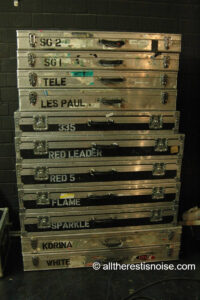 industry can be a very rewarding experience. The degree of autonomy given to a technician is quite remarkable and as long as it results in what the artist is looking for sonically, he or she is given free reign to establish their own working practices and procedures. And that’s a damn rare thing in any industry. Photographer Pennie Smith once described being on tour as “like a commando raid performed by the Bash Street Kids” and while this describes the camaraderie pretty well, it also gives away the almost military style hierarchy and the degree of precision planning needed to make a large tour run smoothly. Being part of that can be hugely fulfilling, every gig is the result of an extraordinary team effort and on the nights when the energies of the crew, performers and audience are in sync, magic truly happens. We are not just putting on a concert, we are in the business of delivering cherished memories to people, some of whom may be changed forever by what they witness. That’s a pretty special thing to be able to do and a privilege to be given the chance to be part of.
FAQ 4- Life of the road- sex & drugs & rock ‘n’ roll eh?
“You’ll be lucky…maybe in the 1970s you would have been right. But back then Black Sabbath were touring with a 700 watt PA. The concert industry has become so much more corporate these days, there is so much at stake financially, it is much more equipment intensive and the public are so aware of their legal rights that if any trace of alcohol or drugs were found in connection with an incident you could forget any kind of insurance. Hammer of the Gods has got a lot to answer for because the truth is these days that that kind of behaviour is not tolerated. You would never be able to give the amount of effort and concentration you need to work a big show today in that kind of state and you would be a liability not only to yourself but to everyone around you. And that is not acceptable to people these days”.
It is difficult to say how the role of guitar technician will change in the future, looking back over its development since the early days its tempting to say that it will change very little, the fundamentals of the job are the same now as they were over 50 years ago. The most used items in the guitar tech’s workbox are still traditional hand tools. Despite the new technologies of amp modellers, in-ear monitors and so on, in the final analysis we are still working for human beings who run around wielding guitars, which are lumps of wood and wire that have been around in various forms for over a century. The guitar may disappear altogether from various forms of music but there are still many genres where it holds a vital place and as the failure of the various attempts to market a self tuning guitar show, there is still going to be a need for a man in black at the side of the stage. After all, if there wasn’t, who would the musician blame for his own fuck ups then…?
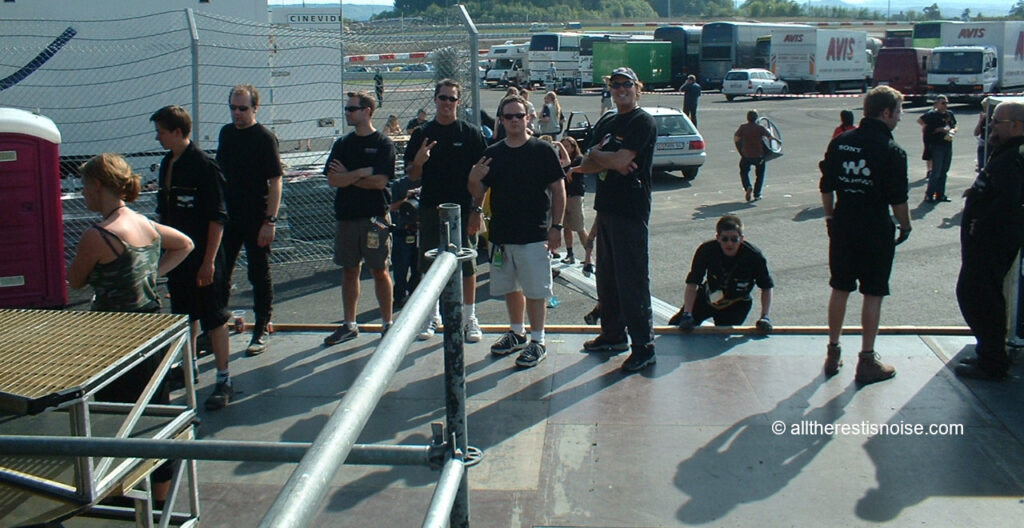
A Day In The Life Of A Guitar Tech.
10AM. A typical day usually stretches to over 12 hours of work and begins around now. The modern tour bus may be comfortable and climate controlled but it can still start to feel like a U-boat after upwards of 10 people have been on it for a while. On a large tour, specialist caterers will have a dining area set up with a hopefully delicious breakfast waiting but anything on a smaller scale will involve finding a local greasy spoon café. After that it is time to go onto the stage for the first time and wander around like an unwashed god almighty, tutting at everybody and everything.
11AM. There should hopefully be a large number of stagehands, AKA local crew, who will be on hand to help with the unloading of equipment from trucks. This is sometimes done in your absence, although this is not advisable as the quality and experience of local crews can vary, so a bit of supervision is recommended. Depending on the size of the stage, getting everything in place can be swift and easy or an absolute nightmare. The sound crew may have amp racks, mixing desks or wireless gear in the way and lighting techs are notorious for putting floor lights and other specials in backline positions and stage access points (and then making the problem worse by not tidying up their cables properly). It all fits in the end somehow and you may even have a line of sight to the stage from your tech position if you are persuasive enough. Tech time begins (string changing, repairs, swearing etc).
2PM. Focusing time. A special time for lighting crew to make sure that all the lights are pointing in the correct directions. This is achieved by alternately blinding everyone and plunging the stage into complete darkness. Techs stop trying to work and wander off to answer emails.
3PM. Linecheck. A game of two halves. The dull half consists of listening to each instrument on the stage one by one until the sound engineers are happy with how everything sounds individually in the room. The good half involves the backline crew playing a bad cover version of whatever song is within their abilities so the audio department can get an idea of what it sounds like all together. Lighting crew get their revenge by constantly firing strobe lights in everyone’s eyes.
4PM. Band soundcheck scheduled. Band are late.
5PM. Band soundcheck. This part of the day could take anything between half an hour and two hours plus, depending on things like how well previous gigs on the tour have been going, how fussy the band are, how echoey the room is or whether they want to try different songs or new arrangements and so on. It can get quite busy and you can find yourself reconfiguring equipment constantly. The band will play bad, hungover versions of their own songs which will be interrupted by lots of chin stroking, looking at the ground and saying unhelpful things like “I’m not sure…it sounds a bit weird”. They will eventually leave the stage satisfied but oblivious to the fact that it will sound completely different when the audience come in.
6PM. Tech time continues, including dealing with any issues that came up at soundcheck. Duties can involve set ups, changing pickups, re-programming, rewiring, changing speakers, re-valving, remarking settings, swapping FX, making cables, polishing, ordering replacements/spares and more string changing and swearing.
7.30PM. Doors open. Time for dinner. This is eaten in the catering area if you are lucky, at the kebab house next door if you are not or even missed altogether if your technical duties are not complete.
8PM. Support band onstage. Continue preparing guitars for main band, get towels and on-stage drinks and have a final pre-gig pee. A set list will arrive at some point and it will be time to plan a tuning strategy due to the number of awkward tunings or capo positions involved.
8.45PM. Changeover (another linecheck performed in front of the audience but without the dodgy cover version).
9.15PM. Showtime. If all goes well, the band will run through a load of songs to a rapturous reception and all you have to do is bring newly tuned guitars on and off stage. If the worst should happen, you will be on and off stage all night, trying to fix things, swapping stuff over, recabling, changing settings and so on and still keep to a hectic tuning schedule. All while being shouted at.
11PM. Encore finishes and house lights go up. All that setting up that went on earlier is now going to be accomplished in reverse but instead of being staggered throughout the day, everyone (backline, sound, lights) are all going to attempt to pack down at the same time. Surprisingly, considering the circumstances, this usually works very well.
12AM. Last backline flightcase is wheeled into the truck and stacked up. Time for a beer…until you hear that your artist wants you in the dressing room. He wants to try changing his gear around before soundcheck tomorrow and wants to discuss it. Bugger.